
Advancing smart environments with coordinated unmanned systems
-
Advancing smart environments with coordinated unmanned systems
The reality of smart environments
Smart environments, like installations, ports, and industrial facilities, need timely, accurate information to operate safely. Fixed sensors and infrastructure provide essential coverage, but they can’t move or adapt as conditions change.
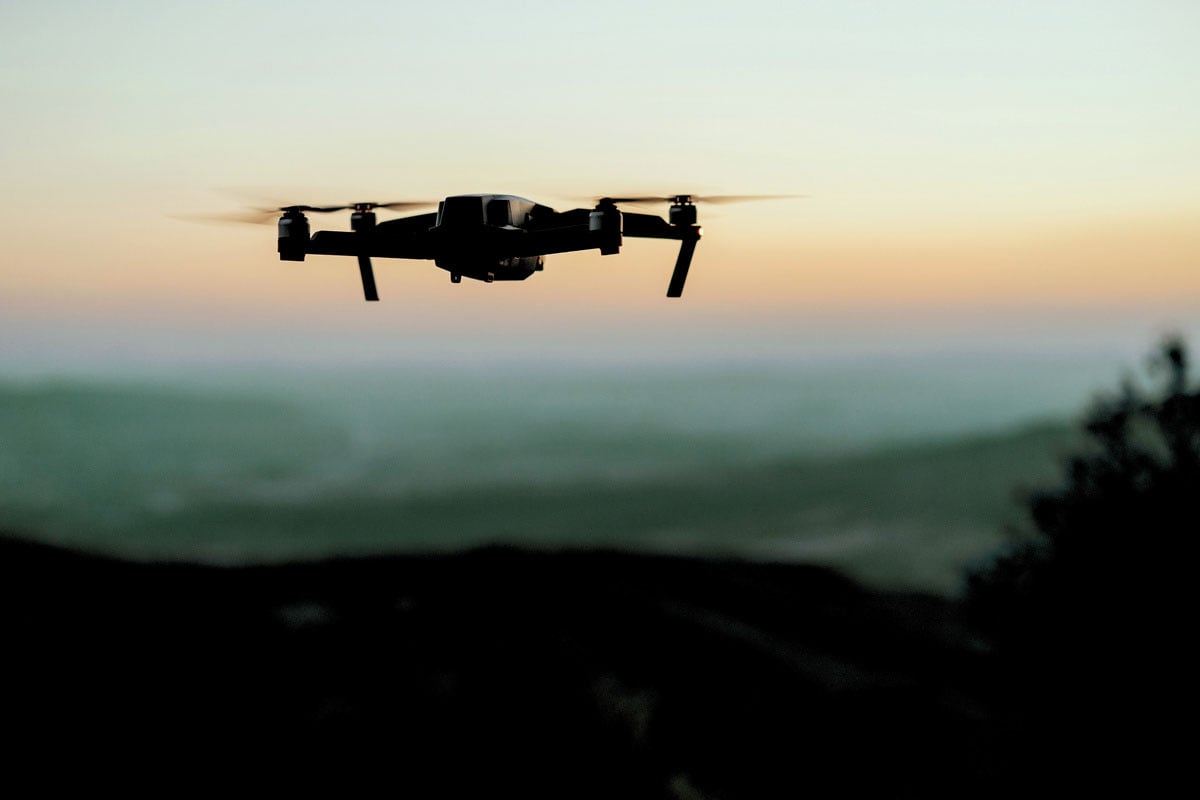
Unmanned aerial systems (UAS) can extend this foundation by providing flexible, on-demand visibility. Their value increases when they’re treated as part of an integrated operational architecture, rather than as standalone tools.
This paper proposes an architectural direction informed by the complementary perspectives of Kamiwaza, NODA AI, and Cachai. It outlines how AI orchestration, autonomous coordination, and distributed systems could be aligned to support more coordinated and resilient unmanned operations.
When operations break down
The challenge for most organizations isn’t adopting unmanned systems, but sustaining them as operations scale. As fleets grow across teams and vendors, workflows fragment, tools multiply, and decisions slow as operators move between systems to assemble context.
Governance and connectivity constraints further limit how data can be used and shared — especially in government and defense environments. Over time, these issues compound, leaving unmanned systems underused. This isn’t because they lack capability, but because the operational model around them doesn’t support coordination, control, or reliability.
The combined capability
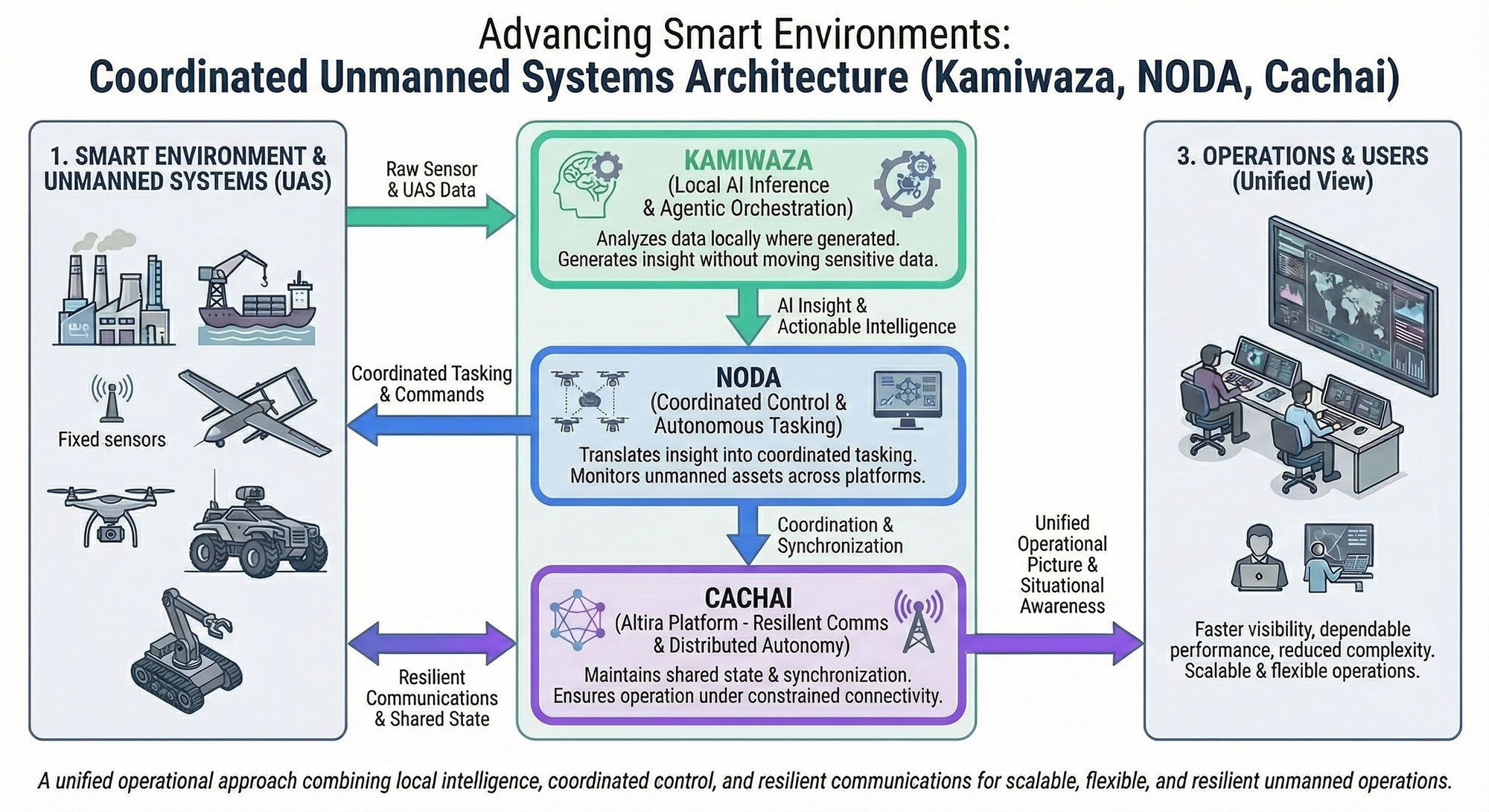
Together, Kamiwaza, NODA, and Cachai outline a conceptual approach to addressing the operational challenges that limit unmanned systems at scale. The model brings together three complementary capabilities: local AI inference that runs where data from UAS and sensors is generated, coordinated control of unmanned assets across platforms and missions, and resilient communications that maintain shared state when connectivity is constrained.
In this proposed architecture:
-
Kamiwaza provides agentic AI orchestration that generates insight without moving sensitive data
-
NODA translates that insight into coordinated tasking and monitoring of unmanned systems
-
Cachai’s Altira platform supplies the distributed autonomy and synchronization needed for the system to function under real-world conditions.
While not presented as a single commercial offering, this model illustrates how intelligence, coordination, and communications could be designed to work together as a unified operational approach, rather than as disconnected tools.
In a conceptual operating model, the combined capabilities of Kamiwaza, NODA, and Cachai illustrate how incident response could become faster and safer. Data from UAS would be analyzed locally through Kamiwaza, NODA would coordinate unmanned assets to assess affected areas, and Cachai’s Altira platform would maintain synchronization when connectivity is limited. The result is a clearer operational picture without exposing personnel to unnecessary risk.
Applied to routine operations, the same model suggests how infrastructure management could become more proactive. Coordinated UAS inspections and local analysis could surface issues earlier, reduce manual site visits, and support more planned maintenance rather than reactive response.

Why this approach works
As a theoretical operating model, integrating Kamiwaza, NODA, and Cachai’s Altira platform illustrates how unmanned systems could extend visibility beyond fixed infrastructure without adding operational complexity. UAS could be deployed and retasked as conditions change, while coordination and communications keep the operational picture consistent across teams. This creates situational awareness that reflects real conditions rather than the limits of static sensor placement. The same model suggests how unmanned operations could remain flexible as platforms, missions, and environments evolve.
Because intelligence, coordination, and communications are not tied to a single vendor or system, organizations could introduce new UAS or retire older ones without disrupting workflows. Data would remain local and governed, while operations continue to function even when connectivity is degraded. Finally, this approach emphasizes usability at scale. A unified operational interface could reduce tool sprawl and training burden, allowing teams to start with a narrow mission and expand over time. New use cases could be added without rebuilding processes, supporting gradual adoption rather than onetime transformation.
Looking ahead
Unmanned systems are becoming an important complement to smart-environment infrastructure, but their impact depends on how thoughtfully they’re integrated into operations. When coordination, communications, and intelligence are designed to work together, organizations can gain faster visibility and more dependable performance without adding unnecessary complexity.
The model described here uses the combined perspectives of Kamiwaza, NODA, and Cachai to illustrate one possible path toward that level of maturity. By keeping intelligence local, coordinating unmanned assets across platforms, and supporting operation under real-world conditions, this conceptual approach highlights how unmanned systems could be used more consistently and at scale.