

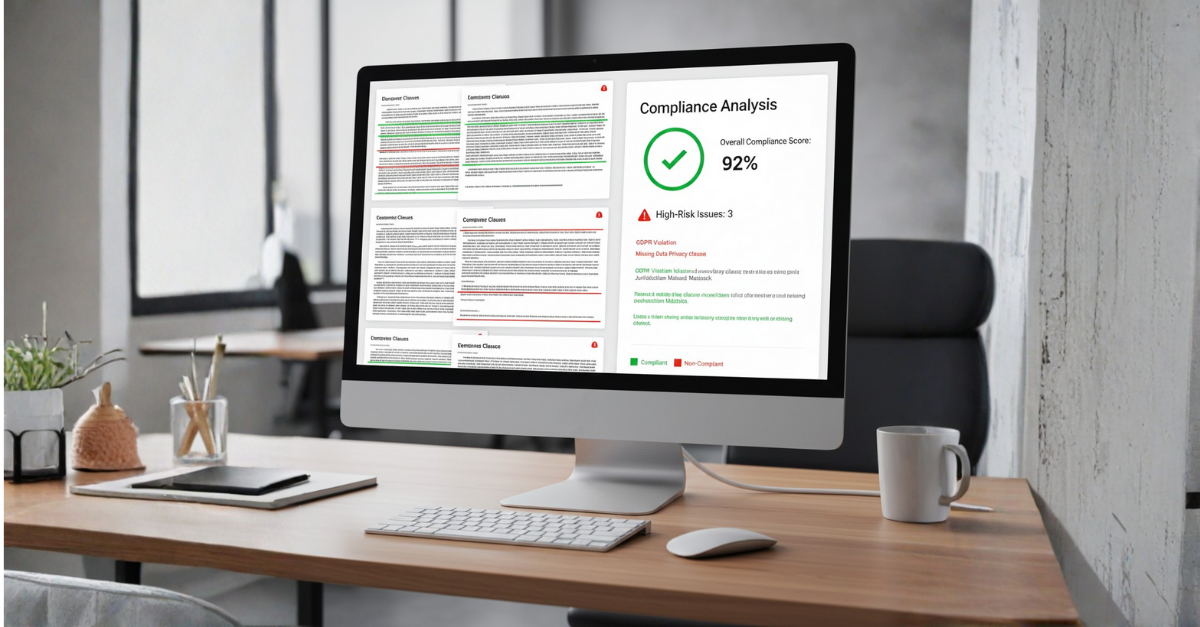
AI Legal Compliance Tools for Workflow Management

Managing compliance has become a time drain for legal departments as they stretch their staff and budgets to stay on top of ever-changing regulations, from data privacy to financial practices to employment law. Their goal? Avoid lawsuits, fines from regulatory bodies, and fallout from reputational damage.
Lawyers are becoming more overwhelmed with regulatory compliance as enterprises expand into new markets and policymakers update their laws. One report found that complying with growing global regulatory complexity is the biggest legal threat to businesses, and that 28% of global law departments say the frequency and complexity of regulatory changes is their biggest anticipated risk. Another recent survey found that 79% of in-house legal leaders are worried that they face higher risk due to regulatory, policy, and business uncertainty.
While all legal teams must monitor regulations and keep their company policies up to date, large organizations in particular need even more coordination and internal control frameworks. Because they operate in many different regions and jurisdictions, each with its own set of policies, it can be a major challenge to continually monitor and maintain compliance with regulations.
The Risks of Non-Compliance
What exactly happens if your legal department doesn’t have the resources to keep up with ever-changing regulations? In short, your entire organization will face increased risk.
More complexity means more risk that something slips through the cracks, whether it’s a data leak or a mishandled contract. Non-compliance can lead to fines that can reach into the millions. For example, the maximum fines for General Data Protection Regulation (GDPR) violations can reach €20 million or 4% of global revenue, whichever is higher. Violations can also cause reputational damage to an organization and its brand or brands.
But there’s also the human impact of non-compliance. Penalties, audits, and reputation damage puts even more stress on legal teams that are already overburdened. This leads to even less time for strategic work and higher rates of burnout. With legal teams pulled between supporting business growth and enforcing compliance, guardrails may weaken if lawyers don’t have the resources they need to handle their workloads.
How AI Legal Compliance Tools Can Help
Legal departments are starting to use both off-the-shelf and custom-built AI tools to manage their compliance workloads, finding much-needed support that comes without additional headcount. These are just a few examples of AI in legal research and regulatory compliance:
- Monitoring changes in regulations across different countries and regions
- Writing or updating company policies related to data handling, labor practices, trade, and other activities that could have legal ramifications
- Generating compliance and corporate governance reports for internal reviews or external audits
- Reviewing contracts for high-risk language or missing clauses
- Managing requests from other departments to ensure legal document compliance
By using the right AI tools in the right workstreams, legal teams can improve their ability to avoid fines, prevent litigation, and protect brand reputation, all while reducing the total number of hours they need to spend on compliance as a whole.
What Are the Best AI Legal Compliance Tools for Workflow Management?
The good news is that legal teams have a lot of choice when evaluating AI software to help with legal compliance. But not all products and platforms work the same way, and it’s critical to watch out for a few things.
The most important consideration is how the AI tool handles data security and privacy. Legal teams know how crucial it is to keep data safe and in compliance with regulations like the GDPR, California Consumer Privacy Act (CCPA), or Health Insurance Portability and Accountability Act (HIPAA). Some AI tools use encryption when sending data from source locations to a centralized cloud or server for processing. As an alternative, legal teams can use specialized orchestration software that allows AI models and agents to access data without moving it, so data never needs to leave its compliant environment.
The best AI for compliance monitoring will also connect siloed document repositories to help ensure that legal departments get complete, accurate information. This means choosing a solution that can maintain a living knowledge graph of contracts, reports, records, and other data that legal teams can proactively monitor for compliance.
Intelligent Document Processing Saves Time for Legal Teams
Kamiwaza built an Intelligent Document Processing (IDP) solution that’s ideal for regulatory compliance and due diligence. It’s unique from other AI tools in that it synthesizes legal documents while keeping them in their native environment. This gives legal teams a fundamentally more secure approach to using AI that significantly reduces the risk of data breaches and simplifies compliance with privacy regulations.
For legal departments that want to use AI agents in their workflows, Kamiwaza offers full auditability. Kamiwaza logs every query and analysis performed by AI agents, giving legal teams a complete, auditable trail to prove compliance.
Lawyers dedicate their careers to protecting the company, and their time deserves protection, too. IDP can save hours of time for legal teams without adding any risk that documents will be exposed. Learn more about the legal use cases that Kamiwaza is enabling with AI orchestration.