

The AI Decision You Can't Take Back
Most enterprise technology decisions are recoverable. You choose the wrong CRM, you migrate. You pick the wrong cloud provider, you lift and shift. Painful, expensive, but survivable. The agentic AI orchestration decision is different, and the enterprise technology community is only beginning to reckon with what that means.
Gartner® put it plainly in a research note published this week:
“The emergence of multiple orchestration entry points signals that enterprises are not only selecting AI platforms, but also choosing how autonomous work will be structured, governed, and scaled throughout the organization. Early platform choices will influence operating models, economic viability, and governance frameworks in ways that are difficult to reverse1.”
This is not a software evaluation. This is an organizational design decision wearing a technology price tag.
What You Are Actually Choosing
Every AI orchestration platform enters the market from a different architectural starting point. Some are built to execute runtime processes at scale. Others structure work through predefined workflows. Some platforms are intent-led, meaning users define goals and agents determine how to achieve them. And others, including Kamiwaza, ground execution in semantic context: the enterprise knowledge, relationships, and meaning that make decisions accurate and defensible across functions and systems.
These are not competing feature sets. They are competing operating philosophies. And the operating philosophy you choose today will shape how your organization makes decisions, assigns accountability, and governs AI-driven work for years to come.
The challenge is that each approach looks reasonable in a proof of concept. Governance gaps, cross-domain coordination failures, and context blindness rarely surface in pilots. They surface in production, at scale, when the cost of re-platforming is measured not in licenses but in operational disruption.
The Cost of the Wrong Starting Point
Consider what happens when an enterprise builds agentic workflows on a platform optimized for runtime speed and tool composability. Agents execute quickly. Integrations are flexible. Early results look strong. But as use cases grow in complexity, the platform struggles to ground decisions in enterprise context. Agents produce outputs that are technically correct but organizationally wrong. Governance becomes an afterthought bolted on after the fact. Cross-functional coordination requires custom engineering that someone has to maintain.
The same dynamic plays out with workflow-centric approaches in organizations that need adaptive, judgment-intensive execution. Processes that work well when decisions are predictable break down when the environment changes faster than the workflow can be updated.
None of this is a criticism of those vendors. It is an acknowledgment that architectural starting points carry assumptions, and those assumptions eventually meet reality.
Why Context Is the Foundation, Not a Feature
Kamiwaza was built around a straightforward problem: large enterprises and government organizations sit on vast amounts of distributed data spread across disparate systems, and when AI acts on that data without understanding the relationships between it, the results are technically plausible but organizationally wrong. The solution was not to ask enterprises to standardize their data before getting started. It was to provide the context layer that makes incoming data accurate and meaningful, regardless of where it originates.
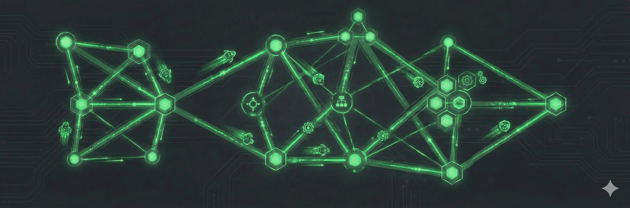
That context layer takes the form of a semantic graph, a living model of enterprise knowledge, relationships, and meaning that grounds every AI decision in what the organization actually knows. For large enterprises and government organizations, the decisions that matter most require exactly this: understanding regulatory constraints, organizational relationships, historical context, and cross-domain dependencies. These are the decisions where an AI system that does not know what it does not know creates the most risk.
Some industry experts categorize semantic approaches as slow to deploy, requiring heavy upfront modeling and specialized teams. That has not been Kamiwaza's experience, or our customers'. Organizations can achieve operational context graphs in months, not years. Additionally, Kamiwaza’s semantic graph is not a static artifact that requires a team of engineers to maintain. It is living, continuously updated, and built with AI assistance and human validation rather than through manual knowledge engineering. The distinction matters, because it changes the calculus on what "upfront investment" actually means in practice.
The alternative is not actually faster. It is deferred complexity. Organizations that skip the context layer do not avoid the work. They delay it until it is significantly more expensive to address, typically at the point where re-platforming would be required.
The Convergence Reality
Gartner's research makes another observation worth sitting with: “as the market converges, value will accrue to organizations that avoid locking into narrow orchestration models and instead build toward unified execution layers that combine intent, workflow, semantics, and infrastructure.”
We are already seeing this underway. The question for enterprise buyers is not whether convergence will happen. It is which platforms are genuinely on that path and which are marketing in that direction while extending an architectural legacy that was never designed for enterprise complexity.
Kamiwaza was built to converge. Our semantic foundation is not a ceiling; it is a starting point from which workflow control, intent planning, and runtime governance extend naturally. We are not adding governance as an afterthought or retrofitting semantic context onto a process engine. The architecture was designed from the beginning to serve the execution needs of organizations where getting AI decisions wrong carries real consequences.
The Questions to Ask Before You Commit
If you are evaluating AI orchestration platforms, your evaluation should go deeper than category placement. Here are the questions that matter:
- How does this platform handle decisions that cross organizational boundaries, where no single workflow owns the outcome?
- What does governance look like in production, not in the pitch deck, but in a real deployment with real accountability requirements?
- If this platform becomes the foundation of how our organization executes autonomous work, what does replatforming look like in three years, and are we comfortable with that answer?
And perhaps most importantly: is this vendor's roadmap genuinely oriented toward convergence, or are they extending what they already built and calling it AI orchestration?
The Window Is Narrowing
The enterprises making these decisions today are not early adopters experimenting with AI at the margins. They are organizations deploying AI to govern real workflows, make real decisions, and take real actions at scale. The stakes of the platform decision have grown accordingly.
Gartner is right that early choices will be difficult to reverse. That is not a reason to delay. It is a reason to slow down only long enough to make the right call. The organizations that treat this as a software procurement decision will spend the next several years managing the consequences. The ones that treat it as an operating model decision, and choose their platform accordingly, will be the ones that look back on this moment as the point where they got ahead.
Learn more about the Kamiwaza AI Orchestration platform today.
GARTNER is a trademark of Gartner, Inc. and its affiliates.