
Getting Beyond the Scale Gap: Why Enterprise AI Fails to Scale

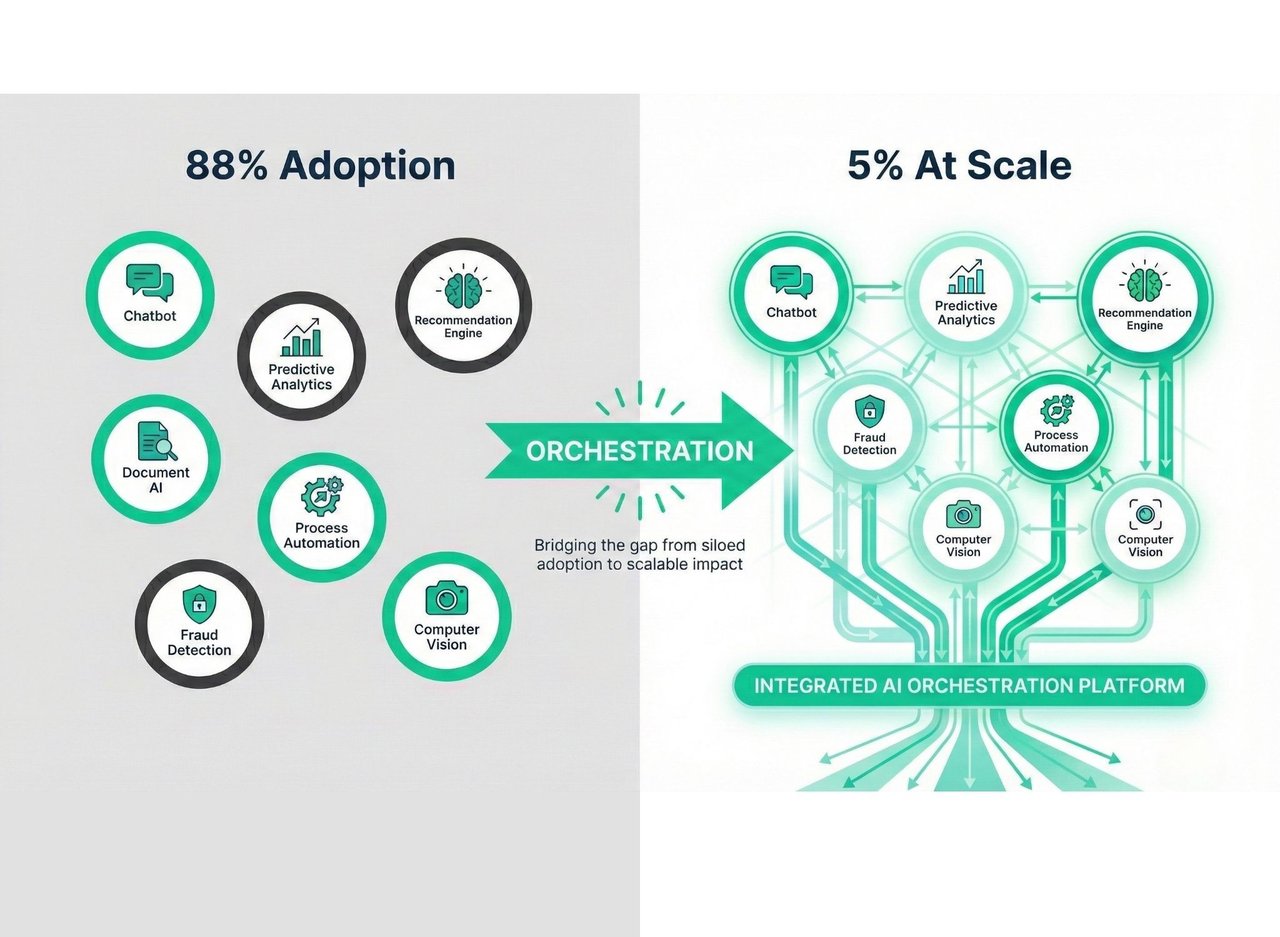
Enterprise AI has reached an inflection point, but not the one most organizations hoped for. While 88% of companies now use AI in at least one business function, only 5% have successfully integrated AI tools into core workflows at scale. The gap between pilot success and production failure has become the defining challenge of enterprise AI adoption.
This isn't a technology problem. Foundation models have never been more capable, cloud infrastructure has never been more accessible, and AI expertise has never been more available. Yet most organizations remain trapped in what industry analysts call "pilot purgatory," a state where promising proof-of-concepts deliver impressive results in controlled environments but fail to translate into enterprise-wide impact.
The culprit isn't the AI itself. It's the architecture AI is being deployed into.
The Scale Gap: Where AI Adoption Breaks Down
Enterprise AI adoption follows a predictable pattern. Initial pilots succeed because they run on staged data within narrow boundaries. A customer service chatbot works well when connected to a single CRM system. A document classifier performs admirably when processing files from one department. A fraud detection model delivers results when analyzing transactions from a single payment rail.
These controlled experiments validate that AI can work. They demonstrate value. They generate executive enthusiasm and unlock additional budget. Then comes the hard part: scaling beyond the pilot.
When organizations attempt to expand AI across departmental lines, regulatory domains, and infrastructure layers, they encounter the same structural limits that made other forms of integration difficult and expensive . Each new use case introduces more uncertainty, duplication, and ad-hoc access paths. The fragmentation that already exists in the enterprise becomes exponentially more complex.
While adoption is broad, impact remains shallow. Only 39% of organizations report measurable EBIT gains from their AI investments, revealing the gap between experimentation and value capture.
The operational overhead compounds as use cases multiply. Engineering resources get consumed by maintaining integrations rather than building new capabilities. Security teams struggle to enforce consistent policies across heterogeneous environments. Data teams spend more time reconciling access patterns than enabling new workflows. A 2025 Forrester survey found that 41% of organizations cite too many disconnected platforms as a primary inhibitor to scaling AI, while 49% report competing priorities between IT, data, and business teams. Each AI initiative requires negotiating access, securing budget, aligning stakeholders, and establishing governance protocols from scratch.
This creates what economists call diseconomies of scale, where each additional unit of output costs more than the previous one. In practical terms: Your fifth AI use case is at least as expensive and time-consuming as your first.
Why Traditional Approaches Fall Short
The conventional response to AI scaling challenges centers on consolidation. Organizations are told they must centralize data into single repositories or rewrite legacy systems before AI can operate effectively. This "data lake first" mentality promises that once everything flows into one place, AI will have the clean, accessible information it needs.
This approach fails for three fundamental reasons.
First, data gravity makes centralization prohibitively expensive. The larger and more distributed enterprise data becomes, the more costly and risky it is to move. Migration projects that were estimated at 18 months stretch to three years. Data quality issues discovered during migration require extensive cleanup. Business operations dependent on legacy systems face disruption risk. The ROI calculation that justified the project assumes value delivery begins immediately, but in reality, organizations spend months or years resolving issues like inconsistent field names, mismatched data types, and duplicate records before seeing any return.
Second, regulatory constraints make centralization impossible in many contexts. Highly regulated industries face data sovereignty requirements, privacy regulations, and compliance mandates that prevent sensitive information from leaving approved infrastructure. Healthcare organizations cannot freely move Protected Health Information across boundaries. Financial institutions face restrictions on where customer data can reside. Federal agencies operate across multiple classification levels that prohibit data commingling. For these organizations, "centralize first" isn't just expensive—it's legally prohibited.
Third, centralization doesn't solve the coordination problem. Even when data successfully migrates to a central repository, AI systems still need to coordinate across multiple environments during execution. They need to invoke tools across different security boundaries. They need to respect access controls that vary by system. They need to maintain audit trails that satisfy different regulatory frameworks. Moving the data doesn't eliminate the need for orchestration—it just delays the moment when organizations must solve the real problem.
The Orchestration Alternative
AI orchestration provides a fundamentally different approach. Rather than attempting to eliminate fragmentation through consolidation, orchestration creates a coordination layer that operates across distributed systems. This shifts the challenge from "how do we move all our data" to "how do we coordinate intelligent systems across the infrastructure we already have."
This architectural pattern establishes standardized ways to handle data access, workflow execution, model invocation, and policy enforcement across heterogeneous environments. Instead of building custom integrations for each AI use case, teams rely on a unified control plane that provides these capabilities consistently. Each new AI implementation builds on existing foundations rather than starting from scratch.
The value shows up in three ways.
First, orchestration respects data gravity. Instead of moving data to where models can access it, orchestration routes intelligence to where data already lives. Models and agents operate locally while remaining governed by enterprise-wide policy. This minimizes data movement, reduces latency, maintains compliance, and eliminates disruptive architectural changes. Organizations can activate their data immediately rather than waiting years for migration projects to complete.
Second, orchestration embeds governance into execution. Traditional access control makes decisions once, based on identity and role. AI systems that determine their own behavior at runtime need something more sophisticated. Orchestration evaluates every request contextually, considering the agent's purpose, data sensitivity, and regulatory constraints at the moment of execution. This contextual approach supports dynamic workflows that traditional role-based access control cannot handle, while maintaining the consistent enforcement that compliance requires.
Third, orchestration enables compounding returns. Without coordination infrastructure, each AI use case requires building new integrations, establishing new governance procedures, and creating new monitoring capabilities. The cost of deployment remains high regardless of how many use cases already exist. With orchestration, the operational overhead decreases as the shared infrastructure matures. Teams use the same patterns for accessing data, the same mechanisms for enforcing policy, and the same tools for monitoring behavior. Adding new AI capabilities becomes progressively easier, allowing organizations to move from linear scaling to compound value creation.
This is how organizations move from isolated pilots to coordinated capability, the shift that makes enterprise-wide AI impact achievable rather than aspirational.
What Orchestration Enables in Practice
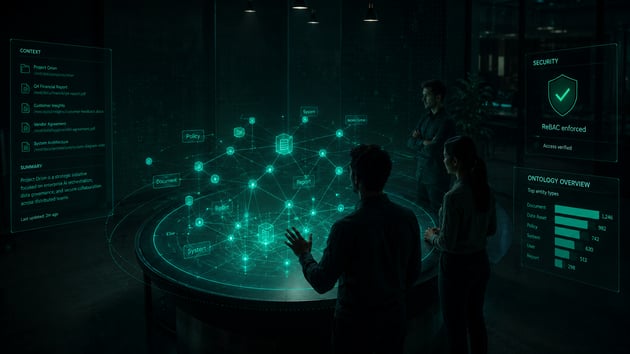
The difference between orchestrated and unorchestrated AI shows up most clearly in production environments. Kamiwaza's approach to AI orchestration demonstrates how the right platform architecture solves these coordination challenges in real enterprise workflows.
Consider insurance underwriting. Generating accurate quotes requires accessing data from policy management systems, claims history databases, third-party risk assessments, and carrier rate sheets. Without orchestration, each data connection requires custom integration work. When systems change (a database upgrade, a new vendor API, a security policy update) integrations break and require manual fixes. The underwriting team waits days for IT to restore functionality.
Kamiwaza's Distributed Data Engine provides standardized connectivity across these disparate sources without requiring data migration. When an underwriting agent needs to assemble a risk profile, it accesses information through governed pathways that enforce policy consistently regardless of where data resides. System changes get absorbed by the platform rather than breaking individual integrations. Quote generation that took days becomes real-time, and IT maintains one coordination layer instead of dozens of point-to-point connections.
In healthcare claims processing, adjusters review evidence from patient records in the EHR, provider notes, lab results, imaging studies, and billing codes. Each system has different access controls, data formats, and audit requirements. Traditional approaches force adjusters to manually log into each system, extract relevant information, and piece together the complete picture. The process is time consuming.
The Kamiwaza platform allows agents to coordinate this work automatically while respecting the security and privacy controls each system requires. Agents inherit the adjuster's specific permissions through Relationship-Based Access Control (ReBAC). If the adjuster can't access certain records, neither can the agent. Every access gets logged for HIPAA compliance. Claims that required weeks of manual review now complete in hours, and the audit trail that regulators require generates automatically.
In federal intelligence analysis, analysts cross-reference information across multiple classification levels and legacy systems. Manual searching, correlation across security boundaries, and synthesis while maintaining strict separation of classified and unclassified information is time-consuming, error-prone, and limits decision speed.
Kamiwaza enables agents to operate across these environments while maintaining rigorous security controls. Classification boundaries remain enforced, information doesn't inappropriately migrate between security levels. But the coordination work that consumed analyst time happens automatically, allowing human experts to focus on judgment and decision-making rather than data gathering.
Research from McKinsey shows that high-performing AI organizations are nearly three times more likely to have fundamentally redesigned workflows, a key factor in capturing meaningful business impact from AI investments. This workflow transformation requires orchestration infrastructure that can coordinate across the complexity of real enterprise environments.
Moving Forward
The path from pilot to production doesn't require waiting for perfect data or unified systems. It requires coordination infrastructure that works with the complexity that already exists in enterprise environments.
Organizations that recognize this shift gain a fundamental advantage. They can deploy AI on existing infrastructure rather than rebuilding it. They can establish patterns that compound rather than duplicate. They can create consistency without requiring uniformity. Most importantly, they can deliver the enterprise-wide impact that justifies AI investment, not someday after a multi-year transformation, but now, on the systems that already run the business.
Kamiwaza provides the AI orchestration platform that makes this possible, coordinating AI across distributed infrastructure, embedding governance into execution, and enabling organizations to scale AI capabilities with the teams they have today.
The scale gap isn't permanent. It's solvable. But solving it requires recognizing that the problem isn't AI capability. It's coordination architecture.