

The Missing Economies of Scale in Enterprise AI | Kamiwaza

Enterprise leaders launch AI initiatives expecting a familiar economic pattern: the fifth implementation should cost less than the first. Experience should translate to efficiency. Learnings should compound. Each new use case should deploy faster and cheaper than the last.
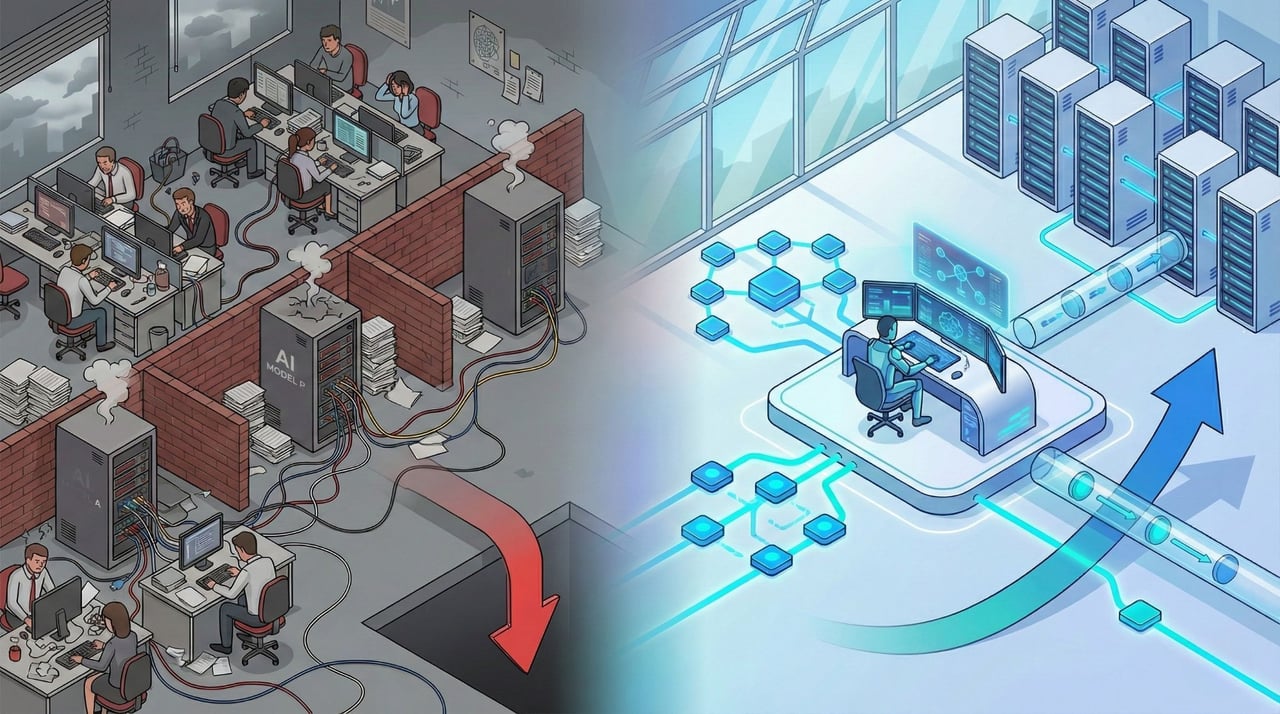
Instead, they discover something different. The fifth use case requires the same integration work as the first. The governance review takes just as long. The talent allocation remains constant. The operational burden multiplies rather than diminishes.
This isn't a hidden cost. It's missing economies of scale. Organizations are paying full price for each AI implementation because they lack the infrastructure to capture efficiencies that should naturally occur with repeated deployment.
Why Efficiencies Don't Materialize
In traditional enterprise software deployment, organizations naturally capture economies of scale. The tenth server installation is faster than the first. The fifth system migration costs less than the initial one. Teams develop playbooks, build reusable tools, and establish patterns that transfer across implementations.
AI should follow the same trajectory. Teams should get faster at data integration after connecting their third system. Security reviews should accelerate once governance frameworks exist. Talent should become more productive as they recognize familiar patterns. Yet research shows this doesn't happen.
The problem stems from how AI implementations are structured. Each use case gets treated as an independent project with its own requirements, its own integrations, and its own governance process. This approach prevents the learning transfer that creates economies of scale in other technology domains.
Integration Work Remains Custom
An organization deploys its first AI use case and builds integrations to connect the model with necessary data sources. This work is substantial but feels like a one-time investment. Success leads to a second use case, which requires different data sources and therefore different integrations. The third use case needs yet another set of connections. By the fifth implementation, teams have built dozens of point-to-point integrations, each requiring separate maintenance.
Model Context Protocol (MCP), a client-server protocol designed to make it simpler to connect models to tools and data sources, somewhat mitigates this problem. However, as a protocol, it lacks key support for security, auditability, and consistent use across different networks and infrastructure. So, while it makes developers’ lives a bit easier, it pushes key enterprise challenges to security and infrastructure teams.
The integration work never becomes easier because nothing is completely reusable. Each connection is customized for specific systems and data formats. When infrastructure changes, integrations break and require manual intervention.
This pattern violates the fundamental principle of economies of scale: repeated activity should generate reusable assets. In manufacturing, the hundredth unit costs less than the first because production processes improve. In enterprise AI without coordination infrastructure, the hundredth integration costs the same as the first because each one is built from scratch.
Governance Reviews Don't Accelerate
Security and compliance reviews should become more efficient with experience. The first AI implementation requires establishing new governance frameworks, defining approval workflows, and documenting security protocols. This foundational work is time-consuming but creates assets that subsequent implementations should leverage.
Instead, organizations discover that each AI use case operates in a slightly different regulatory context. For example, a bank might use a fraud detection model for payment data, which has strict compliance requirements, but also a marketing recommendation engine to upsell customers, which would have different operational needs. Similarly, a healthcare company might utilize AI to accelerate claims processing, a function that must strictly comply with HIPAA controls. This is vastly different from using AI for supply chain optimization, such as managing the inventory and delivery of critical medical supplies and pharmaceuticals. Nearly 60% of AI leaders cite integrating with legacy systems and addressing risk and compliance concerns as their primary challenges in adopting AI.
This fragmentation prevents governance efficiency gains. Rather than conducting one comprehensive security review that covers all AI implementations, organizations perform separate reviews for each use case. The expertise developed during the first review doesn't transfer to the second because the security contexts differ.
Talent Productivity Plateaus
Specialized AI talent should become more productive with each implementation. Data engineers learn how to prepare datasets efficiently. Integration specialists develop faster connection methods. Security professionals refine their review processes. This productivity improvement is how organizations typically capture value from experienced teams.
The productivity gains fail to materialize when each AI implementation follows a different pattern. Engineers working on fraud detection cannot easily apply their knowledge to credit risk assessment because the systems and approaches differ. The skills required for one use case don't fully transfer to the next. MIT research reveals that internal AI builds succeed only one-third as often as purchased solutions, largely because organizations lack the sustained expertise required to build, deploy, and maintain custom AI systems at scale.
Organizations respond by staffing each AI initiative with dedicated resources. The headcount requirement grows linearly with the number of AI initiatives because teams cannot effectively share resources across projects that lack common patterns.
The Architectural Root Cause
The missing economies of scale trace back to treating each AI use case as an independent project. This approach makes sense for initial pilots where requirements are uncertain and speed matters more than long-term efficiency.
Problems emerge when organizations attempt to scale beyond pilots using the same project-by-project approach. Production implementations encounter the full operational complexity that pilots were designed to avoid: distributed data across multiple systems, workflows spanning departments, and regulatory requirements that vary by context.
Organizations respond by treating complexity as use-case-specific rather than systemic. Each implementation team solves integration challenges for their particular scenario. Each security review addresses governance requirements for a specific context. This localized problem-solving prevents the creation of reusable patterns that would enable economies of scale.
The result is what Deloitte research describes as a persistent gap between experimentation and true business transformation. Organizations accumulate AI use cases without accumulating the organizational capabilities that make subsequent implementations faster and cheaper.
How Orchestration Captures Efficiencies
Economies of scale emerge when organizations can reuse assets across multiple implementations. In enterprise AI, this requires a control plane that coordinates across all use cases rather than treating each as independent.
AI orchestration provides this control plane. Rather than building custom integrations, organizations establish standard methods for accessing data. Rather than conducting separate governance reviews, teams define policies centrally and enforce them consistently. Security is rooted at the platform level, with role-based access ensuring data never moves from its secure environment.
Kamiwaza's AI orchestration platform serves as this control plane. The Distributed Data Engine brings AI processing to where data lives, eliminating the integration complexity that prevents scale efficiencies. AI agents query and process information directly in its secure environment across clouds, data centers, or edge locations.
Once this foundation exists, efficiencies emerge at the AI project level. Teams building agents or automating workflows no longer recreate data access patterns or navigate separate governance reviews. The infrastructure handles these concerns consistently. The first agent might take three months to deploy. The fifth deploys in weeks. The twentieth deploys in days.
This is what missing economies of scale look like when recovered: the organizational capability to deploy AI faster and cheaper with each successive implementation.
Related Reading
For more on the foundational challenges that prevent enterprise AI from scaling beyond pilots, see Getting Beyond the Scale Gap: Why Enterprise AI Fails to Scale.