
Why Vectors Aren't Enough: The Case for Context-Driven AI

Retrieval-Augmented Generation (RAG) promised to make enterprise AI reliable. Feed your AI a vector database of internal documents, let it retrieve relevant chunks at query time, and you get answers grounded in your own data. In theory, it is a clean solution. In practice, it routinely falls short, especially for complex enterprises.
The reason is not a retrieval problem. It is a meaning problem.
What Vectors Actually Capture
Vector embeddings are remarkably good at surface-level semantic similarity. Ask a question, retrieve the nearest neighbors in embedding space, and pass those text fragments to your model. For narrow, well-scoped use cases, this works well.
But enterprise data is not a collection of similar documents. It is a web of data relationships. A policy document refers to a regulation. That regulation governs a product. That product is sold by a team. That team operates inside a business unit. When an AI needs to answer a consequential question, it is not retrieving a document. It is navigating a graph of relationships, each with context that shapes the meaning of the answer.
Vectors capture proximity. They do not capture structure, hierarchy, lineage, or intent. The result is an AI that matches keywords without understanding context, and that misses critical connections between data that lives in different systems or formats.
The Missing Layer: A Context Graph
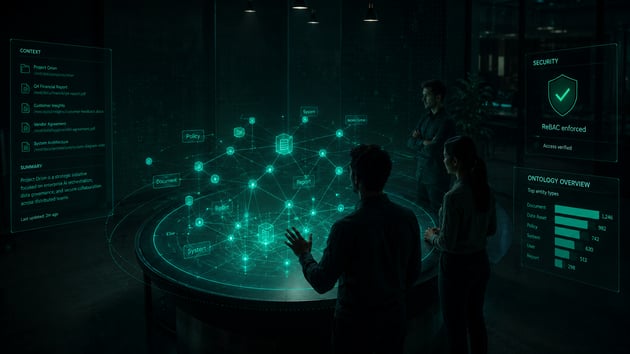
What complex enterprises need is a context graph: a structured, semantic representation of how data elements relate to one another across the organization. Not a flat index of document chunks. A map of meaning.
This is where ontologies become operationally important. Ontologies define the formal relationships between concepts, entities, and data types within a domain. They provide the scaffolding that lets an AI reason about data rather than simply retrieve it. When an AI understands that a "claim" relates to a "policy" which relates to a "risk class" which is governed by a "regulatory filing," it can generate answers that reflect the actual structure of your business, not just the surface text of your documents.
Effective context management at enterprise scale requires this ontological layer. Without it, you are handing your AI a dictionary when what it needs is a map.
Why Most Enterprises Have Not Solved This
The traditional answer to this problem has been data centralization: move everything into a data lake, normalize it, build a knowledge graph on top of it. That approach is expensive, slow, and difficult from a regulatory standpoint. It requires moving sensitive data across systems, reconciling competing data ownership models, and maintaining a centralized structure that is perpetually out of date.
The alternative is to send the AI to the data, rather than moving the data to the AI. This shifts the architecture fundamentally. Instead of extracting and centralizing data to build a context graph, you build the context graph in place, across your existing systems, without requiring migration or consolidation.
Living Ontology: Context Management That Stays Current
Kamiwaza's Living Ontology capability is designed to solve exactly this problem. Rather than requiring a static, pre-built knowledge graph, Kamiwaza’s ontologies continuously map the relationships and semantics across your enterprise data sources as they exist today. It turns raw, distributed data into a dynamic context graph that reflects how your data actually relates, updates as your data changes, and remains synchronized with the systems of record your business already relies on.
This is the difference between AI that retrieves and AI that understands. Retrieval gives you the closest match. Context management gives you the right answer for the right reason, grounded in the full structure of your data, not just its surface similarity.
For senior IT leaders evaluating AI infrastructure, the question is not just whether your AI can find relevant information. It is whether your AI can reason within the context of your business. Vectors are a starting point. A living context graph is what makes enterprise AI trustworthy at scale.
Discover the power of truly contextual AI. Learn more about Kamiwaza’s Living Ontology feature and how it goes beyond vectors.