

AI Workflow Automation for Legal Teams

It’s impossible to calculate the value that experienced lawyers bring to their teams. They do more than review contracts and maintain compliance. Skilled lawyers can catch hidden risks, prevent expensive lawsuits, and avoid regulatory penalties. They can serve as strategic partners to other departments, training other teams on best practices to uphold reputational credibility and sidestep common mistakes.
But these days, legal departments are losing their valuable time to massive piles of documentation and volumes of data. Electronically stored information (ESI) is growing every year, with legal institutions seeing data growth that often exceeds 20% annually. The eDiscovery market, which involves collecting evidence in the form of email, audio, video, social media posts, and other digital data, is projected to grow from nearly $17 billion in 2024 to more than $39 billion by 2032.
Legal Teams Are Looking to AI to Help Manage Workloads
It’s no wonder, then, that legal departments are very interested in using AI to save time and streamline work. According to a recent study, 63% of corporate law departments say managing the workload and bandwidth of internal resources is their top challenge. The same study found that 30% of corporate law departments were already using an AI tool, and 54% were considering implementing one soon.
AI workflow automation for legal teams will never replace actual lawyers, but it can deliver powerful results. The latest legal workflow automation software can automate contract review, legal intake, and document management. This leads to faster review and analysis and higher accuracy by eliminating human error. But more importantly, automation frees lawyers to focus on delivering strategic value, something that software can’t provide.
AI in eDiscovery and Litigation
AI can help legal teams prepare for cases faster without being overwhelmed by massive amounts of data. Take eDiscovery, for example. AI can help scan email servers, cloud drives, and other digital sources to find files. It can classify documents by topics or people, helping lawyers make connections and find evidence. AI can even perform sentiment analysis to determine positive and negative associations associated with key individuals.
Throughout the litigation cycle, AI can quickly identify relevant documents and flag potential issues. Lawyers can assess cases faster and enjoy having less data and documentation to manually review. In turn, legal teams may see fewer cases of burnout, less professional exhaustion, and a high retention of talent.
AI for Legal Contract Review and Management
Reviewing contracts can be one of the most time-consuming tasks in a legal department. One recent report found that 40% of legal operations team members spend four to five hours a day reviewing and managing contracts. These reviews involve understanding the business objective, checking the party names, scope of work, payment terms, and other conditions, and identifying any risks or liabilities.
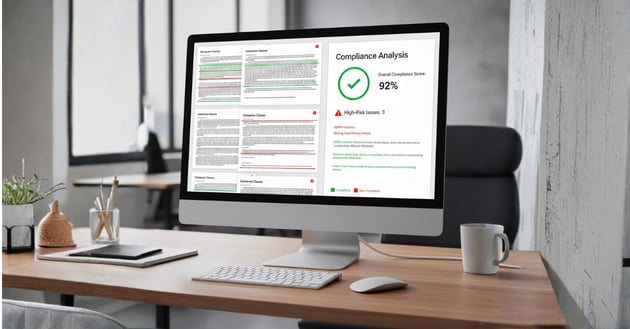
AI can read and interpret contracts much faster than a human lawyer can. The latest AI software can interact with contacts to identify key clauses, risks, dependencies, and obligations. This helps legal teams manage the entire contract lifecycle much faster, and with much less human involvement.
What AI Solutions Can Legal Teams Use for Workflow Automation?
Legal departments can find dozens of software products that use AI to automate intake, routing, approvals, and other common workflows. These are all great for simplifying the steps in a workflow, but they may require extra steps and precautions when it comes to keeping data secure.
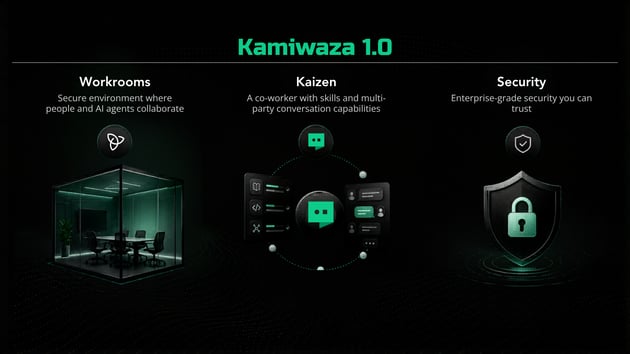
Kamiwaza’s Intelligent Document Processing (IDP) solution goes further with a secure, decentralized AI orchestration platform that was designed specifically for enterprise legal departments. Unlike other solutions, Kamiwaza sends AI models to data sources, eliminating the need to centralize data. As a result, legal departments can use AI for document review, legal research, and compliance monitoring without loosening security standards.
Kamiwaza’s IDP reads and understands documents to support popular legal use cases, including eDiscovery and litigation, contract review and management, and regulatory compliance. Even though they never move, documents become a living resource, giving lawyers the ability to ask and interact with data in a new way. For example, a lawyer can ask, “Show me all contracts that depend on certifications expiring in the next 90 days.” Kamiwaza can scan thousands of agreements, identify every linked certification, and instantly answer, “Six contracts expiring soon, totaling $95 million in revenue.”
What Are the Best AI Agents for eDiscovery and Document Review?
There are a few important factors for legal teams to consider when choosing AI agents for eDiscovery and document review. How an agent handles data is critical, and the best AI agents will be able to process data without moving it. They’ll also be able to understand the context of a document to provide more helpful insights.
How will you use regulated data while keeping it secure?
Legal teams often handle data that’s protected under data privacy and security laws. They need to make sure to protect both client information and business records, including contracts, litigation materials, emails, and personnel files. Kamiwaza’s IDP solution includes a distributed data engine that can access data without moving it, eliminating the need to create copies of sensitive information. This way, AI models can process data without risking compliance with data privacy regulations.
How will you ensure data accuracy?
It’s critical that legal teams have access to trustworthy, up-to-date information. Kamiwaza’s IDP solution uses data ontologies to connect documents such as governing master agreements, certification requirements, and contract dependencies. This helps ensure data accuracy, structure, and completeness across complex document environments.
How will you decide who can access documents?
Documents must be kept confidential in order to preserve attorney-client privilege, and even sharing a document too widely within the same company can put that privilege at risk. Role-based access controls (RBAC) limit document access to only those who need to know. Kamiwaza’s IDP solution reinforces security with RBAC so that only authorized users can access certain materials and data. This granular level of control is essential for protecting privileged information and intellectual property.
What insights will be available?
Some AI agents rely on keywords and metadata to categorize documents. Kamiwaza’s IDP solution goes beyond keyword matching and metadata, using vision models to review documents. The solution uses AI to understand document relationships and their business implications, helping identify potential issues and offer recommendations to legal teams.
Kamiwaza Helps Reduce Work and Risk for Legal Teams
While other software vendors require legal departments to duplicate or centralize their data, an approach that is expensive, time-consuming, and risky, Kamiwaza works in a different way. By allowing the data to stay where it is for AI processing, Kamiwaza reduces the risk of data exposure and eliminates the need to host a data lake and pay for additional computing resources.
When done the right way, AI and automation can help legal teams make the most of their valuable hours. It’s a worthwhile investment in departmental efficiency that also, happily, can lead to a more satisfied legal team that’s likely to stick around. Learn more about legal use cases for workflow automation.