
Context Window Specifications vs. Retrieval Performance

Model vendors frequently announce larger context windows, often citing these specifications as a primary capability. While large context windows suggest the ability to reason over vast datasets, technology leaders implementing retrieval-augmented generation and agentic workflows must evaluate how these specifications translate to performance in practical applications.
A recent benchmark study provides data regarding these performance claims. Signal65, in collaboration with Kamiwaza, published research on the Retrieval Intelligence and Knowledge Extraction Rating (RIKER.) The study evaluated 91 models using a contamination-resistant retrieval benchmark across context sizes ranging from 32K to 200K tokens. The findings indicate that advertised context length is not always a consistent proxy for retrieval accuracy.
Why most benchmarks cannot answer this question
Before the results, it is worth understanding why this benchmark is different, because the methodology is the reason the findings are trustworthy.
Most public benchmarks suffer from three problems that make their leaderboards nearly useless for predicting enterprise outcomes. The first is training contamination. When a benchmark relies on a static, public dataset, models can absorb the answers during training, so a high score can reflect memorization rather than capability. The second is the use of an LLM as a judge, where one model grades another's output. That introduces subjectivity and bias into the score. The third is that many tasks are shallow extraction or pattern matching that look nothing like the multi-step retrieval real enterprises depend on.
RIKER addresses all three by inverting how the test is built. Instead of starting with documents and annotating answers afterward, it starts with a structured database of ground-truth entities and relationships, then generates a fresh document corpus from those answers. Because the answer key is defined before the documents exist, grading is deterministic. There is no human annotation and no model acting as judge. And because the corpus can be regenerated at will, no model can memorize it. The test also maintains consistent relationships across documents, so it can pose realistic multi-document questions rather than isolated lookups. The result is a benchmark you can actually trust to approximate enterprise knowledge work.
What 91 models revealed
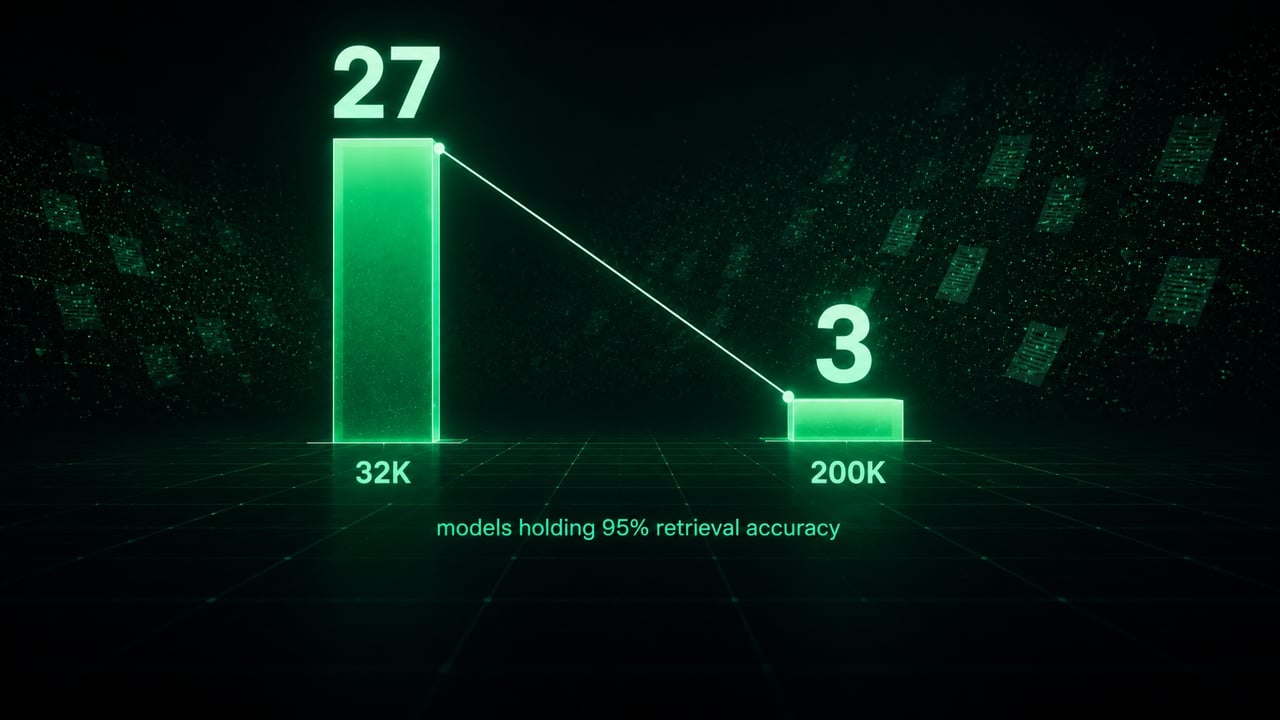
The results clarify the relationship between window size and accuracy. At a 32K context size, 27 models achieved at least 95% retrieval accuracy. However, at 200K, only three models maintained this level of performance. Many models that perform similarly at moderate context lengths show significant divergence as the window size increases, with most exhibiting decreased accuracy. Larger context windows did not inherently result in improved retrieval.
The second finding concerns multi-document tasks. RIKER distinguished between simple single-document lookups and multi-document aggregation, where a model must synthesize information across multiple records. Aggregation accuracy decreased more rapidly than single-document retrieval as context grew, declining by an average of 26% at 200K. At this scale, no model maintained above 95% accuracy on aggregation tasks. For instance, one model’s performance decreased from 92% at 32K to 24% at 200K. These data points suggest that synthesis tasks may be more susceptible to performance degradation at scale.
The third finding points toward what actually helps. Reasoning models, the ones that think before answering, swept every top spot. Compared to their non-thinking counterparts, they improved retrieval accuracy by up to 64% in the most dramatic case, with one model jumping from 59% to 97% simply by enabling reasoning. This suggests that how a model is configured can matter as much as which model you choose.
The fourth finding is subtle but important. Hallucination behavior held far steadier than retrieval accuracy as context grew. The willingness of a model to say "I do not know" rather than fabricate an answer declined only modestly at long context, while retrieval and aggregation fell sharply. That tells us retrieval failure and hallucination are partially distinct problems. A model can stop finding the right answer well before it starts making things up, and most evaluations never isolate the two.
What this means for how you buy and build
The practical takeaway for technology leaders is to change the question you ask vendors. A token cap tells you what a model can ingest, not what it can reliably retrieve. The more useful artifact is a retrieval-stability curve: how accuracy holds across context scale, broken out by single-document versus aggregation tasks, and measured with reasoning settings made explicit. Peak accuracy on a short context is the easiest number to advertise and the least predictive of production performance. Stability across scale is what determines whether your deployment holds up.
There is a deeper architectural implication as well. If no single model is reliable across every context size and every task type, then betting your enterprise AI strategy on one model, chosen by its largest published number, is a fragile design. The findings argue for an approach that treats model selection as a runtime decision rather than a one-time purchase. Different workloads need different models and different reasoning configurations, and the layer that routes work to the right model, manages context deliberately, and measures retrieval against ground truth is where reliability actually comes from. This is the orchestration problem, and it is why benchmarks like RIKER matter beyond the leaderboard. They give enterprises a defensible basis for the decisions that one inflated spec was never qualified to make.
RIKER is one part of a broader measurement effort. It complements KAMI, an earlier Signal65 and Kamiwaza benchmark focused on agentic capability, and a forthcoming project called PINNACLE that will extend the framework to additional enterprise dimensions. The shared premise across all three is worth stating plainly. Evaluating production AI requires evaluation methods built for production AI.
The architectural decisions facing technology leaders require evaluation methods that move beyond single-metric specifications. Prior to finalizing architecture based on context length, analyzing a model’s retrieval-stability curve may provide a more accurate representation of how it will handle enterprise document sets in production environments.
For the full analysis of the RIKER benchmark and the implications for your enterprise AI strategy, read the complete report.