
Run Decentralized Inference Where Your Data Lives

Generate unified intelligence to see actionable insights from distributed systems. Kamiwaza's Inference Mesh adds large language model (LLM) reasoning to your data without moving it. Now your AI can see the big picture.

Raw Results Aren’t Actionable Intelligence

Even when your retrieval systems can find the right data, users often struggle with too much information and not enough understanding.

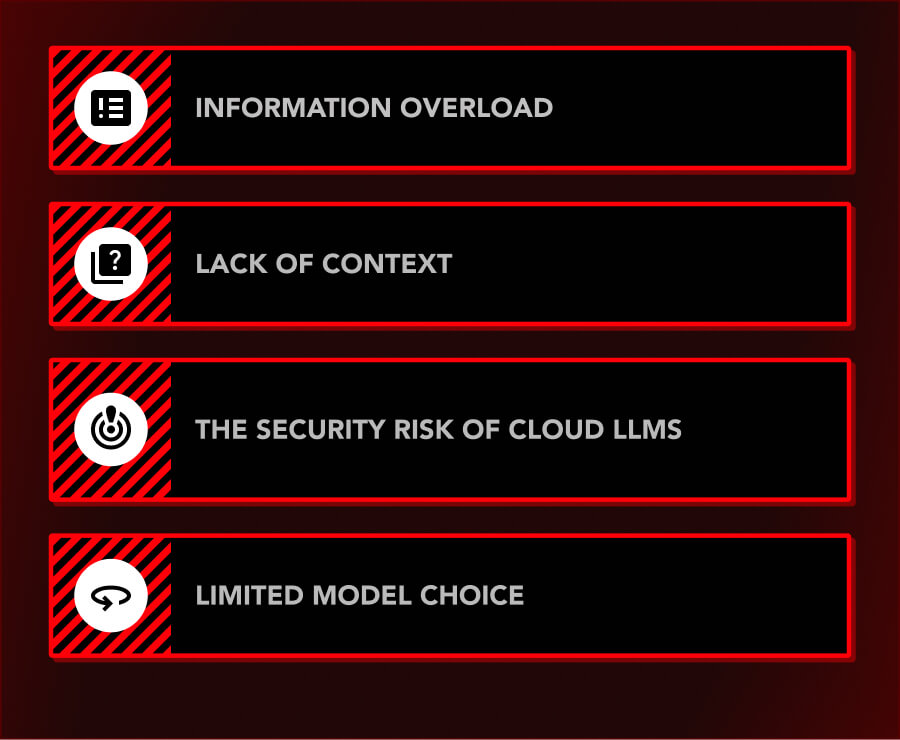
  • Information overload - Users get long documents or complex datasets, but don’t have time to synthesize them into actionable insights.
  • Lack of context - Raw results often need explanation or connection to broader context, which standard search can’t provide.
  • The security risk of cloud LLMs - Sending internal search results or sensitive data snippets to a public cloud LLM API is a major security and compliance violation waiting to happen.
  • Limited model choice - You might be locked into a single provider’s LLM, unable to use the best model for a specific task.

With the power of LLMs applied to your internal data, you can make faster decisions that are backed by real business intelligence.
raw-results-arent-actionable-intelligence
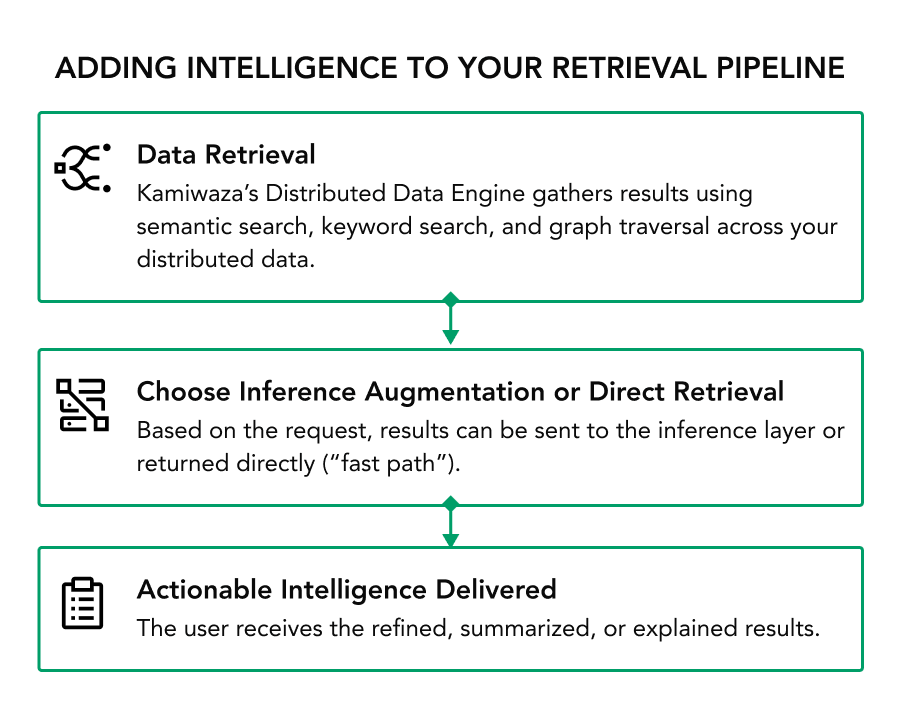
infographic-adding-intelligence-to-your-retrieval-pipeline

Secure, Decentralized Inference for Distributed Data

Kamiwaza's Inference Mesh routes AI to data across distributed systems, so you can run inference in many different locations on a single platform.

  • Bring intelligence to data where it resides
    Inference Mesh enables comprehensive LLM capabilities across your distributed infrastructure. Instead of limiting reasoning to centralized data, you can now bring intelligence to wherever your data resides. This eliminates intelligence gaps and ensures no data source is left behind, regardless of its location or mobility constraints.
  • Run inference on any type of hardware
    Streamline infrastructure and reduce costs by using existing compute assets, regardless of vendor or generation. Inference Mesh works across any silicon, including CPUs and GPUs from NVIDIA, Intel, AMD, and Ampere, eliminating vendor lock-in. Inference requests are automatically routed to the best hardware.
  • Keep data secure and in place
    All Inference Mesh processing happens locally within your secure environment. Results are enhanced without ever sending sensitive information to a service or location outside your control, so you can maintain compliance with data privacy regulations and policies.

FAQs About Decentralized Inference

How Is Decentralized Ai Inference Different From Traditional Inference?

Some of the most valuable enterprise data lives in challenging places for AI processing. Manufacturing sensor data streams at the edge. Financial transactions flow through regional systems. Healthcare records remain locked in local compliance boundaries.

Traditional AI platforms can cost millions by requiring data to be centralized. This is not only expensive, but time consuming. Centralizing data may not even be possible in highly regulated industries or where data sovereignty is required. Decentralized inference creates an intelligent fabric that processes data wherever it naturally resides. Instead of moving data to intelligence, Kamiwaza’s Inference Mesh brings intelligence to data.

What Results Can Enterprises See with Decentralized Inference?

Organizations implementing decentralized inference report transformational outcomes. A global logistics company reduced package routing optimization from hours to minutes by processing at distribution centers rather than centrally. A healthcare network improved patient outcomes by analyzing medical data within hospital boundaries rather than attempting centralization.

Your competitive advantage depends on the speed and quality of decision-making. Kamiwaza’s Inference Mesh makes it possible and practical to deploy AI everywhere data lives. Rather than building a bigger data center, the Inference Mesh creates an intelligent nervous system that extends throughout your enterprise, sensing and responding at every level.

Does Decentralized Inference Deliver Results Faster Than Centralized Inference?

Yes, distributed processing often delivers faster results than centralized approaches. When traditional systems analyze data from multiple locations, they must first gather that data centrally in a data lake or similar datastore. This process can take hours for large datasets and be prone to error over time. Kamiwaza’s Inference Mesh triggers parallel processing at each location simultaneously and avoids the processes that can introduce data error.

Imagine a retailer needing to understand inventory patterns across 5,000 stores for a flash sale decision. A centralized approach would require gathering point-of-sale data from every location, possibly taking hours. The Inference Mesh activates intelligence at each store simultaneously. Within minutes, localized insights flow back: which stores have excess inventory, which face stockout risks, which show unusual demand patterns. The retailer makes informed decisions in minutes, not hours.

This speed advantage compounds with scale. The more distributed your operations, the greater the performance benefit of mesh processing. What seems like architectural complexity actually simplifies operations by eliminating the bottleneck of data movement.

What Are the Characteristics of Decentralized Inference?

Kamiwaza’s Inference Mesh makes distributed AI practical through several innovations:

  • Intelligent routing ensures each query finds the optimal path through the mesh. When you ask a question requiring data from multiple sources, the mesh automatically identifies which nodes hold relevant data, routes requests appropriately, and synthesizes responses. You see unified intelligence, not the underlying complexity.
  • Parallel processing enables simultaneous operations across the mesh. Instead of sequential analysis, the mesh activates all relevant nodes concurrently. A financial risk assessment might simultaneously analyze trading patterns in New York, London, and Tokyo, delivering comprehensive results in the time it would take to analyze a single location.
  • Result synthesis combines distributed insights into coherent intelligence. The mesh intelligently merges responses, resolving conflicts, identifying patterns, and delivering unified insights that respect the contribution of each node while providing holistic understanding.
How Does Decentralized Inference Keep Data Secure?

Every enterprise operates within boundaries: regulatory, security, organizational, and technical. Traditional AI platforms treat these boundaries as obstacles to overcome. Kamiwaza’s Inference Mesh treats them as features to preserve.

When European data protection laws require customer data to remain within EU borders, the mesh processes EU data within EU nodes. When healthcare privacy regulations demand strict access controls, healthcare nodes operate within those constraints. When manufacturing trade secrets must remain within factory walls, factory nodes process data without external exposure. Organizations can deploy AI across their entire operation without violating a single policy, regulation, or security requirement.

How Does Decentralized Inference Reduce Costs?

Kamiwaza’s Inference Mesh eliminates the hidden costs of centralization. Traditional approaches require massive investments in data movement, central infrastructure, and ongoing operations. The mesh leverages existing infrastructure, eliminates data movement, and scales incrementally.

Consider the total cost of ownership. Centralized AI requires building and maintaining massive data pipes, central processing facilities, and complex synchronization systems. The Inference Mesh uses your existing infrastructure, adding only lightweight coordination. Data stays where it lives, eliminating transfer costs. Processing happens on existing systems, avoiding new infrastructure. The economics become compelling at any scale.

How Does Decentralized Inference Differ From the Way You Would Deliver Data Context to Centralized or Cloud-based Models?

With traditional AI services, you must send data to a third party. Decentralized inference creates an intelligence layer that operates wherever your data lives. Kamiwaza’s Inference Mesh wraps around your existing data infrastructure to create this layer. This fabric consists of intelligent nodes with computational capabilities matched to each location and role. A node at a manufacturing facility might specialize in equipment monitoring and predictive maintenance. A node in your financial systems might excel at fraud detection and risk analysis. A node at the retail edge might focus on inventory optimization and customer behavior analysis.

These nodes form a coordinated mesh that shares insights while respecting boundaries. When a supply chain query requires understanding across manufacturing, logistics, and retail, the mesh orchestrates parallel intelligence at each location. Manufacturing nodes analyze production capacity. Logistics nodes evaluate shipping constraints. Retail nodes assess demand patterns. The mesh synthesizes these distributed insights into unified intelligence without ever moving the underlying data.

How Can I Run Inference on Distributed Data Sources?

Enterprises can start running inference on distributed data sources with the Kamiwaza AI orchestration platform. Inference Mesh runs inference where your data lives and works on hardware from any vendor.

planet

Turn Your Data Into Intelligence Securely

Stop choosing between powerful AI insights and data security. Discover how Kamiwaza’s Inference Mesh adds secure LLM enhancement to your distributed data.