

Distributed AI Inference Is an Enterprise Architecture Decision

During an AI pilot, the easiest available model endpoint often determines where inference runs. The team proves that a use case works, measures the quality of the output, and moves on to the next experiment, but scaled production changes the decision. Once AI begins using customer information, internal research, transaction records, or operational systems, inference location determines which infrastructure receives sensitive context, which controls apply during processing, and how much authority the enterprise retains over the workload.
Production architecture must therefore make inference placement explicit rather than inherit it from the model endpoint selected during a pilot. Organizations need the ability to run AI in the environment that fits the work, whether that environment is a data center, an approved cloud, an edge location, or a combination of them. Local infrastructure does not suit every workload, so placement should remain aligned with the company's architecture, risk tolerance, and operating requirements.
Inference Placement Determines the Control Boundary
Inference is the point at which a deployed model receives inputs and produces a result. In an enterprise workflow, those inputs may include far more than a user's prompt. An agent can retrieve records, assemble contextual information, invoke tools, and send intermediate results to additional models or services. Each step expands the system boundary that security, infrastructure, and risk teams must understand.
The 2026 interagency guidance on model risk management emphasizes risk-based governance, comprehensive model inventories, documentation, validation, and ongoing monitoring, including for vendor and other third-party products.[1] Inference placement affects how institutions carry out those responsibilities because it determines which systems process data, which dependencies participate in the workflow, and where monitoring and contingency controls must operate.
Control therefore extends beyond the storage location of the source record. An enterprise also needs to know where retrieved context is assembled, which model processes it, whether the output may cross an organizational or jurisdictional boundary, and what evidence remains after the task completes. A data residency policy cannot answer those questions on its own.
A Centralized Default Creates a Second Architecture
Centralized inference remains appropriate for many workloads, such as when corporate teams use an approved cloud service to summarize public research, develop training materials from nonsensitive sources, or support general productivity. Shared infrastructure can simplify early experimentation and provide elastic capacity when demand changes quickly.
Problems emerge when the same default is applied to work that depends on protected or proprietary information. Sensitive inputs may need to travel from systems of record into a separate processing environment. The enterprise must then extend identity, access, logging, retention, incident response, and continuity controls into that environment. Even when the underlying service is well managed, the organization has created another data path and another operational dependency.
Financial regulators already expect institutions to understand comparable dependencies. Joint guidance from the Federal Reserve, Federal Deposit Insurance Corporation, and Office of the Comptroller of the Currency instructs banking organizations to evaluate third-party access to systems and confidential information, the provider's controls, operational resilience, ongoing monitoring, and options for transitioning a service elsewhere or bringing it in-house. The guidance is technology-neutral, but the implications apply directly when an external service becomes part of an AI inference path.
The U.S. Department of the Treasury has also identified data privacy and third-party providers among the risks that financial firms must consider as AI adoption grows. Its work on cloud adoption notes that concentration risk depends partly on how institutions use and design cloud services, rather than on the mere presence of large providers. Architecture choices therefore shape the risk profile.
Distributed AI Inference Should Follow the Enterprise Architecture
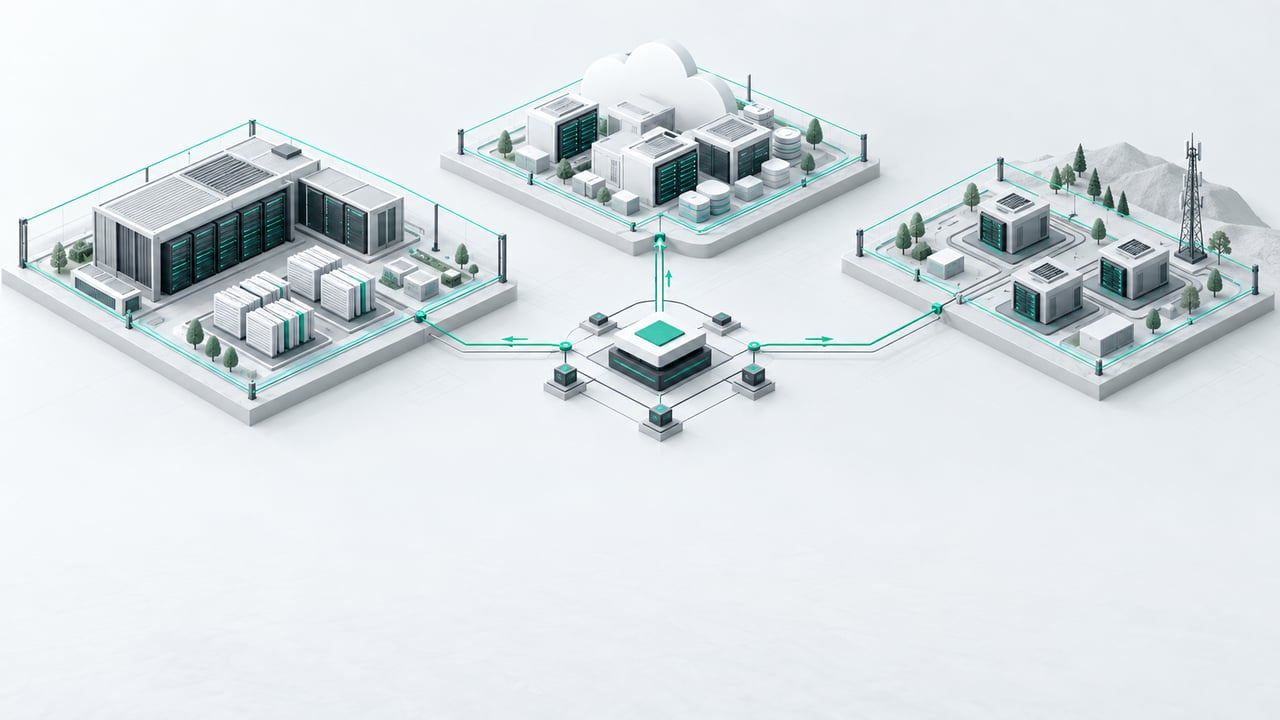
Distributed AI inference places model execution across multiple approved environments instead of requiring every request to travel to one central location. Placement can reflect where the relevant data lives, which compute is available, how quickly the workflow must respond, and which security or regulatory boundaries apply.
Distribution does not mean that every model must run on premises. A low-risk corporate workflow may remain in an approved public-cloud environment, while a customer-risk workflow runs in a private environment near governed records. A time-sensitive process may run closer to an operational system, while a compute-intensive but less sensitive job uses centralized capacity.
The enterprise gains a placement choice for each workload while preserving a common operating model. Policies can define approved environments, models, data classes, and output paths. Platform teams can then apply those policies consistently without rebuilding the application whenever a model or infrastructure requirement changes.
A Financial Services Workflow Shows How Placement Changes
Consider a hypothetical financial institution introducing an AI-assisted investigation workflow. Customer profiles and transaction records remain in governed systems across several regions. Investigators need a consolidated view of relevant activity, related entities, prior cases, and applicable internal policies. Corporate teams elsewhere in the same organization also use AI for lower-risk tasks based on public or approved nonsensitive information.
A centralized design could send the investigation context to the same environment used for corporate productivity. Doing so would require the institution to approve that environment for customer and transaction data, establish the permitted retention and output behavior, extend monitoring, and plan for service interruption or exit. The productivity use case and the investigation use case would share an architectural dependency despite having very different risk profiles.
A distributed design separates the placement decision from the user experience. The investigation request can be routed to an authorized inference environment near the governed data. Permitted results, supporting sources, and relevant provenance can return to the investigator without copying the underlying records into a new central repository. Corporate teams can continue using approved centralized services for lower-risk work. Both use cases remain part of the enterprise AI program, but each operates inside the boundary appropriate to its data and purpose.
Placement alone does not establish compliance, guarantee security, or remove the need for model validation. Legal interpretation, risk ownership, testing, and human oversight remain essential. Distributed inference gives those functions a more precise control surface because the organization can decide where processing occurs and which information may leave each environment.
Use a Placement Policy Instead of a Universal Default
Enterprise architects can turn inference location into a repeatable decision by evaluating five questions drawn from the control, performance, governance, and portability considerations described above:
1. What authoritative data, approved models, and compute environments does the workload require?
2. Where may that information be processed, and which information may cross a boundary?
3. What latency, availability, and connectivity does the business process require?
4. How will permissions, source provenance, logs, and human escalation remain intact?
5. Can the workload move when models, infrastructure, regulations, or business requirements change?
Answers should produce an enforceable placement policy rather than a diagram that becomes obsolete after deployment. The policy can route a request to an approved environment, restrict the data and tools available there, define which results may return, and preserve the evidence needed for review. Teams can revisit the policy as requirements change without redesigning the whole workflow.
Distributed Execution Still Requires Unified Orchestration
Distribution without orchestration can produce another form of sprawl. Separate teams may deploy inconsistent model endpoints, security controls, monitoring practices, and integrations. A workable architecture needs centralized policy and visibility even when execution occurs across distributed environments.
Kamiwaza approaches that requirement through an enterprise AI orchestration layer. The Kamiwaza Distributed Data Engine connects to data where it resides, while the Kamiwaza Inference Mesh supports placing AI processing within the appropriate enterprise environment. Together with permission-aware access, contextual grounding, and auditable execution, those capabilities allow enterprises to coordinate work across clouds, data centers, and edge environments while keeping placement aligned with their architecture.
A distributed design requires more than a set of model endpoints. The platform must connect workloads to the right data, route processing to an authorized environment, preserve the relevant controls, and combine permitted results into a useful response. Without that coordination, distribution transfers complexity from data movement into application development and operations.
Architecture Should Decide Where Intelligence Runs
AI inference should fit the enterprise environment in which the business already operates. Centralized services remain valuable for appropriate workloads, but they should be an intentional placement option rather than the automatic destination for every request. Regulated data, proprietary information, operational constraints, and resilience requirements may call for processing elsewhere.
Organizations that establish workload placement as an architectural policy can expand AI without surrendering control of their data paths, infrastructure choices, or operating model. Explore Kamiwaza's architecture to see how distributed data access and inference orchestration can support AI across the environments your enterprise already trusts.