
Workspaces, Not Sessions: A New Model for Enterprise Agent Governance

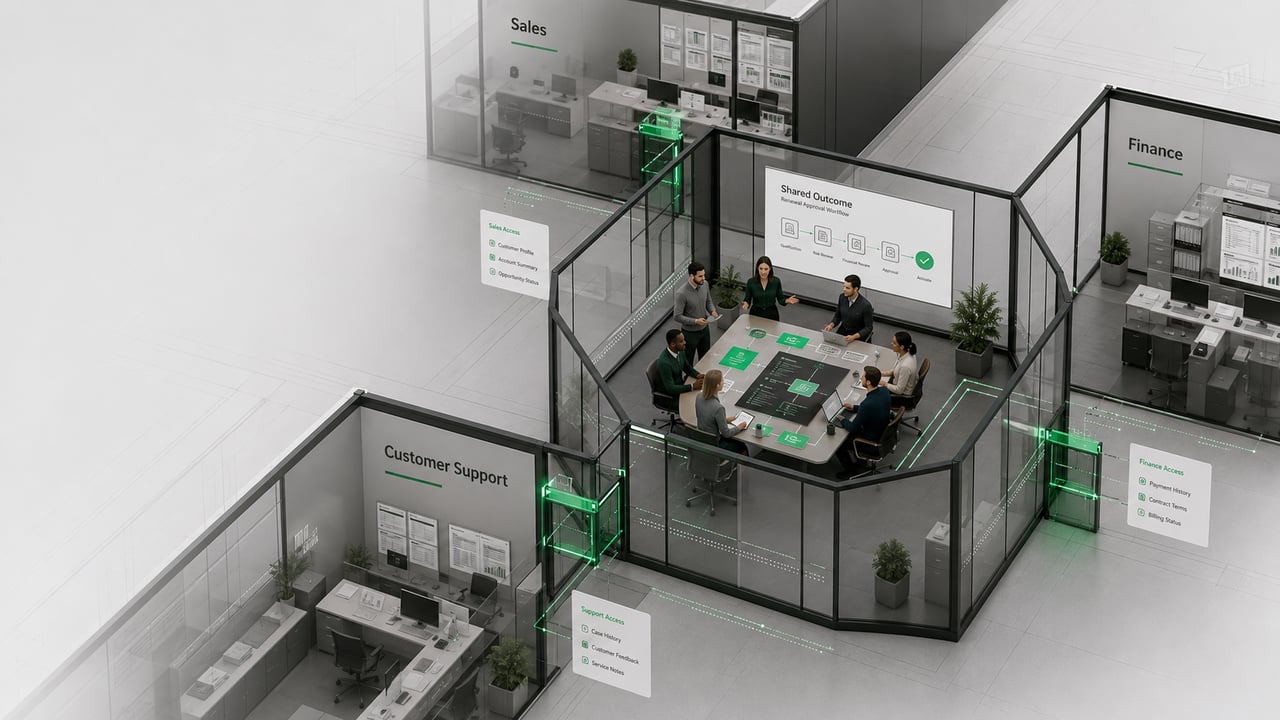
For an AI agent to function as a genuine digital co-worker rather than a stand-alone chatbot, it needs to move across the same organizational boundaries a human colleague would. A single meaningful business outcome rarely lives inside one team's systems: qualifying a renewal opportunity might require pulling from a sales team's pipeline data, a support team's case history, and a finance team's billing records, each governed by a different owner with a different set of entitlements.
A sales operations agent can reason across all three data sets in principle, yet the moment its task requires it to move between finance, sales, and support systems, it runs into the same wall that has slowed cross-functional software integration for two decades: permissions designed around a single department do not travel gracefully to a shared outcome. Most agent deployments were not built to cross that wall, and the tools many enterprises still rely on have no durable way to carry the right permissions with them when they try.
Why AI Agents Stall When Work Crosses Team Boundaries
Interoperability, not model capability, is usually the real constraint once an agent leaves the platform it was built on. Agents built on a common platform tend to share architecture, orchestration, and memory, which lets them operate smoothly inside that platform's boundaries. The moment a task requires reaching a system owned by a different team, that shared foundation disappears. There is no standard way for an agent to carry only the permissions its task requires into a system it does not natively belong to, so organizations default to blunt solutions: broad service accounts that grant more access than any single task needs, or narrow point integrations built one system pair at a time that become brittle and expensive to maintain as the number of connected systems grows. Every additional system an agent must reach multiplies the questions at stake: who owns this data, what can this agent see in this particular context, and who is accountable if the agent gets it wrong.
The Session Model Was Not Built for This
Much of today's enterprise AI tooling still assumes a session: a bounded, single-user interaction that starts, produces an answer, and ends. Sessions work reasonably well for individual productivity, but they were never designed to represent a cross-functional outcome that unfolds over days, involves multiple people and agents, and touches systems governed by different teams. A session carries no durable concept of who else is participating, what each participant is entitled to see, or how the interaction should be recorded once it closes.
That gap shows up clearly in the governance data. A recent Deloitte survey of more than 3,200 IT and business leaders found that only 21 percent of organizations have a mature governance model in place for agentic AI, and that roughly 80 percent lack the basics: clear boundaries defining which decisions an agent can make independently versus which require human approval, real-time monitoring that flags anomalous behavior, and audit trails that capture the full chain of an agent's actions. Session-based tools were not designed to close that gap, because a session retains no persistent record of relationships, ownership, or entitlements once it ends.
What a Governed Workspace Model Looks Like
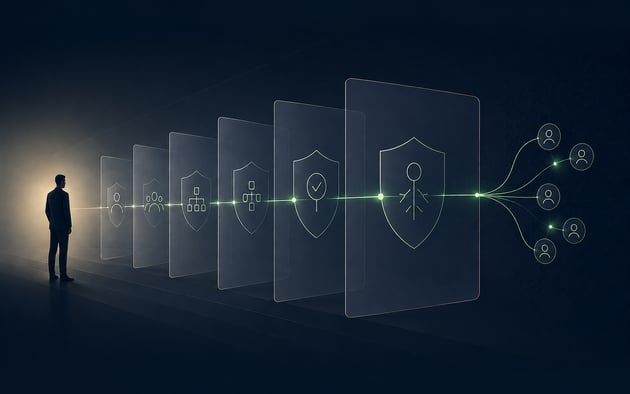
A workspace model addresses the problem differently by treating cross-functional collaboration as a scoped, governed environment rather than a string of disconnected sessions. In Kamiwaza's Workrooms, each engagement is created as an isolated, multi-tenant container built around a specific project or outcome. Access inside that container is evaluated through Relationship-Based Access Control (ReBAC), which determines what a participant, human or agent, can see based on the current relationship among the actor, the task, the data domain, and the organization, rather than a static role assigned months earlier. When the work concludes, the workspace can be torn down, leaving no residual state that could later be exposed or exploited.
That architecture changes what "crossing a boundary" means for an agent. Rather than requesting broad access to finance, sales, and support systems to complete a task, an agent operating inside a workspace inherits only the entitlements appropriate to its role in that specific engagement, and those entitlements can differ for each participant in the same room. A finance analyst and a sales operations agent can occupy the same workspace, share context, and see each other's contributions, while each still sees only the data and tools their own team has authorized. Every request, authorization decision, and output becomes part of one continuous audit record, giving the workspace the kind of evidence a compliance review or incident investigation actually requires.
How Entitlement-Aware Workspaces Preserve Each Team's Boundaries
As agents take on more cross-functional work, accountability has to stay explicit and shared rather than concentrated in one place or lost entirely. The team that owns a given data set remains responsible for how it is used and by whom, even inside a shared engagement, while the platform team shapes the integration patterns that let systems connect safely, and security sets the guardrails that apply across all of them. An entitlement-aware workspace is what keeps that division of responsibility intact during collaboration, rather than forcing a choice between two familiar failure modes. Either data owners grant broad access to keep a project moving, which quietly expands the attack surface and the compliance exposure, or they hold the line on strict silos, which stalls the outcome the business actually needs. A governed workspace gives data owners a third path: retain stewardship of their own systems while still allowing the collaboration to proceed, because the boundary is enforced by the platform at the moment of the request rather than by a manual review each time access is needed.
The practical value of this model shows up in the handoffs that make cross-functional work difficult in the first place. A marketing team building a campaign plan may need visibility into a subset of pipeline data without gaining broad access to the full sales system. A finance team reconciling a contract may need to reference a support ticket without inheriting the customer relationship management platform's entire permission set. An entitlement-aware workspace makes those narrow, task-specific views the default rather than the exception, because access is evaluated at the level of the relationship and the request rather than at the level of the system as a whole.
What Platform and Security Leaders Should Evaluate
Deploying agents across team boundaries raises the stakes on a handful of specific questions that platform and security architects should ask before scaling beyond a pilot.
- Relationship-scoped access. Does the environment scope access to the current relationship and task rather than to a standing role, so permissions can differ by engagement without requiring a new role to be provisioned each time?
- Clean teardown. Does the workspace tear down cleanly once the engagement ends, so no residual data or credentials linger past their intended use?
- Durable audit trail. Does every action inside the workspace, whether taken by a human or an agent, produce a durable audit record tied back to an accountable person?
- Cross-department visibility. Can a data owner in one department see and control what participants from another department, human or agent, are able to access in a shared engagement?
- Support for dynamic collaboration. Does the model support the kind of dynamic, project-scoped collaboration that cross-functional work actually requires, rather than forcing teams back into either broad access or rigid silos?
Organizations whose architecture can actually enforce these answers, with policy setting the standard and the platform holding to it, will be positioned to let agents do the connective work that has traditionally required a person to move information manually between systems, without asking any single team to give up stewardship of its own data. As agent deployments extend further across departmental lines, the platforms built around workspaces, not sessions, will be the ones that can show, months later, exactly who did what, under whose authority, and within which boundary.