
AI & Token Economics

Better AI economics start with context
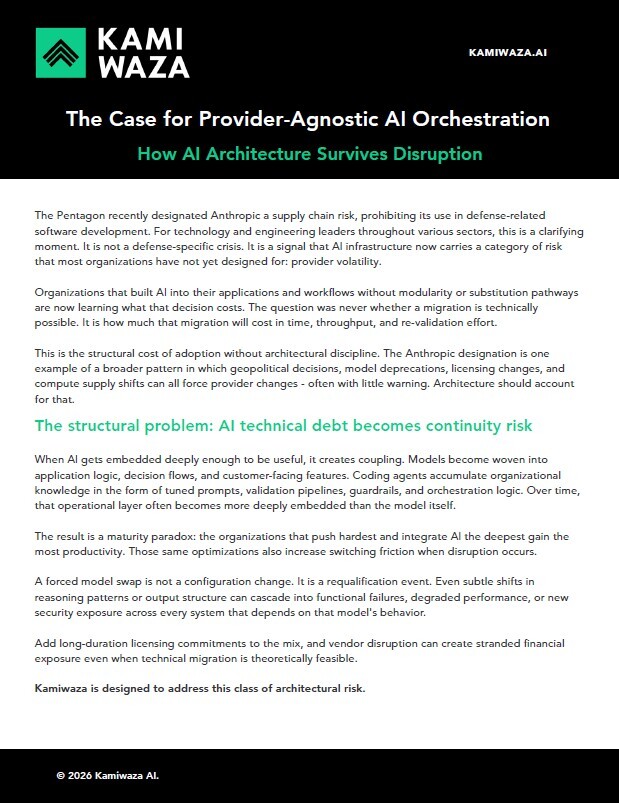
Improve workflow efficiency, keep model and deployment choices open, and evaluate AI by the value each workload produces.
Enterprise AI tokenomics is the practice of predicting and managing the full cost of AI work to maximize the value of each completed outcome. It includes the context processed, retrieval precision, repeated work across agentic steps, model and infrastructure choices, orchestration, and infrastructure utilization.1
Why token-maxing stopped working
Early AI programs encouraged experimentation, resulting in some organizations removing usage guardrails while others published internal leaderboards that rewarded the highest token consumption. Token volume became a proxy for adoption because business outcomes were not yet consistently defined. The incentives worked, but they optimized for activity rather than value. McKinsey reports that 93% of surveyed organizations exceeded their AI budgets and notes that some companies are now taking down AI usage leaderboards.1
93%
of organizations report exceeding AI budgets1
~4x
increase in AI spend from isolated use cases to enterprise adoption1
>5x
expected increase in inference cost per agentic workflow through 20282
$6M
annualized unplanned increase in one enterprise example3
Three stages. Three ROI questions.
Token count describes activity. The economic measure should mature with the workload.
1 Pilot
Purpose: Prove a valuable use case.
Measure: Cost per successful test, accepted answer, or usable insight.
ROI question: Is there value worth scaling?
2 Production
Purpose: Improve a repeatable workflow.
Measure: Cost per completed outcome, cycle time, and quality.
ROI question: Does the workflow improve the business process?
3 Agentic
Purpose: Complete multistep work.
Measure: Total system cost per completed task versus the current workflow.
ROI question: Is the automation worth its full operating cost?
The business case is not fewer tokens at any cost. It is the right intelligence and deployment model for an outcome whose value exceeds its total operating cost.
Where token efficiency begins
Optimize context before changing the model.
Model selection affects the price of each token. Workflow design determines how many tokens the system needs to produce the outcome.
Agentic applications can retrieve and reconstruct context at every step. When retrieval is imprecise, full documents or broad collections of source material may enter the context window to provide the information needed for one answer. A multistep workflow can repeat that process across several model calls.
Each repetition raises input-token volume and the total cost of the completed task. The economic question is therefore both how much the token costs and how efficiently the workflow supplies the model with the context required to produce a useful outcome.
Precise retrieval
Only the context a step needs enters the context window.
Imprecise retrieval
Full documents or broad collections repeat across every model call.
Kamiwaza’s approach
More value from the same model and provider.
Together, these capabilities give workflows a maintained context layer across steps and allow retrieval to focus on the relevant, authorized information.
Context Manager
Saves your files and maps how they connect to one another.
Distributed Data Engine
Connects to data where it already lives across cloud, on-premises, and edge environments, allowing inference to run where the data lives while only results return.
By retrieving only relevant, authorized context at every step, Kamiwaza prevents workflows from repeatedly sending oversized or irrelevant source material. This helps customers send fewer unnecessary tokens to the model and provider.
The model and deployment decision
One orchestration layer. Two economic models.
Workflow efficiency and deployment economics are separate levers. After optimizing the context supplied to each step, the enterprise needs freedom to choose the model and deployment pattern that fit each workload, then change that choice as volume, pricing, capability, or data requirements move.
| Factor | Frontier provider API | Open-weight model, your infrastructure |
|---|---|---|
| How you pay | Provider pricing per input and output token | Compute capacity, power, storage, networking, and operations |
| Economic shape | Low cost to start; variable cost rises with consumption | Capacity investment up front; unit cost can fall as utilization rises |
| Best fit | Low or variable volume, or frontier capability required | Sustained volume, data locality, predictable demand, or deployment requirements |
| Kamiwaza layer | Run the chosen model through Kamiwaza. Provider charges remain direct; Kamiwaza’s platform cost stays separate from token volume. | Run the chosen model on selected infrastructure through Kamiwaza. Kamiwaza’s platform cost stays separate from token volume. |
Deloitte finds that the economic inflection point can shift toward self-hosted infrastructure at sustained volume and estimates that an on-premises AI factory can deliver more than 50% cost savings over three years compared with API and neocloud options. The full infrastructure stack still matters, not GPU cost alone.4
Model and deployment choices should remain reversible
Provider pricing, model quality, and workload requirements keep moving. Enterprises benefit when model and deployment choices remain explicit and can be reconsidered as economics, performance, data location, or deployment requirements change.
Kamiwaza’s approach
Kamiwaza supports model-, silicon-, and cloud-agnostic deployment across cloud, on-premises, and edge environments. Customers choose a model when creating a Kaizen agent or invoking an Inference Mesh endpoint; Kamiwaza does not automatically route among models. That keeps model and infrastructure choice explicit as pricing, capabilities, volume, and deployment requirements change.
Orchestration cost should stay separate from token volume
Provider pricing makes token volume a variable operating cost, and agentic workflows can compound it. Annual platform pricing keeps the orchestration layer predictable as users and workflows scale.
Kamiwaza’s approach
Kamiwaza is licensed annually, so its platform cost stays separate from token volume. Customers can use an open-weight model on infrastructure they choose, including existing infrastructure, or select a frontier provider. Provider token charges remain direct to the customer.
The takeaway
Efficient context. Flexible deployment.
More outcome per dollar.
Token economics is both a workflow decision and an infrastructure decision. Model pricing matters, but the amount of context processed to complete the work matters too. Enterprises need to optimize how context is maintained and retrieved, keep model and deployment choices open, and judge AI by the value of the completed work.
Maintained context
Data and relationships available across environments
Workflow execution
Relevant, authorized context at each step. Less repeated context assembly.
Outcome per dollar
Pilot: value worth scaling. Production: cost per outcome. Agentic: total system cost.
What Kamiwaza changes
Context continuity
Reduce repeated context work
Context Manager persists and indexes documents and graph relationships, enabling applications to retrieve relevant context at each workflow step; it does not automatically carry prompt state across steps.
Retrieval precision
Use the context the task requires
Applications retrieve relevant context at each workflow step, with ReBAC governing authorized workroom, dataset, and document access; this can help avoid repeatedly processing broad source material.
Economic optionality
Keep model and deployment choices open
Choose the model when creating a Kaizen agent or invoking an Inference Mesh endpoint, then reconsider the selection as economics and requirements change. Annual licensing keeps Kamiwaza’s platform cost separate from token volume.
A clearer path from experimentation to scale
Kamiwaza helps enterprises address AI economics at two levels. At the workflow level, Context Manager persists and indexes documents and graph relationships so applications can retrieve relevant, ReBAC-authorized context at each workflow step; it does not automatically carry prompt state across steps. At the deployment level, customers choose a model when creating a Kaizen agent or invoking an Inference Mesh endpoint, selecting a frontier model when its capability warrants provider token charges or an open-weight model on infrastructure they choose when volume, data location, or economics support that path.
Kamiwaza’s annual license keeps platform cost separate from token volume. The result is a clearer path from experimentation to production and agentic scale, measured by whether the workload improves a business process, produces a reliable outcome, or completes work at an acceptable total cost.
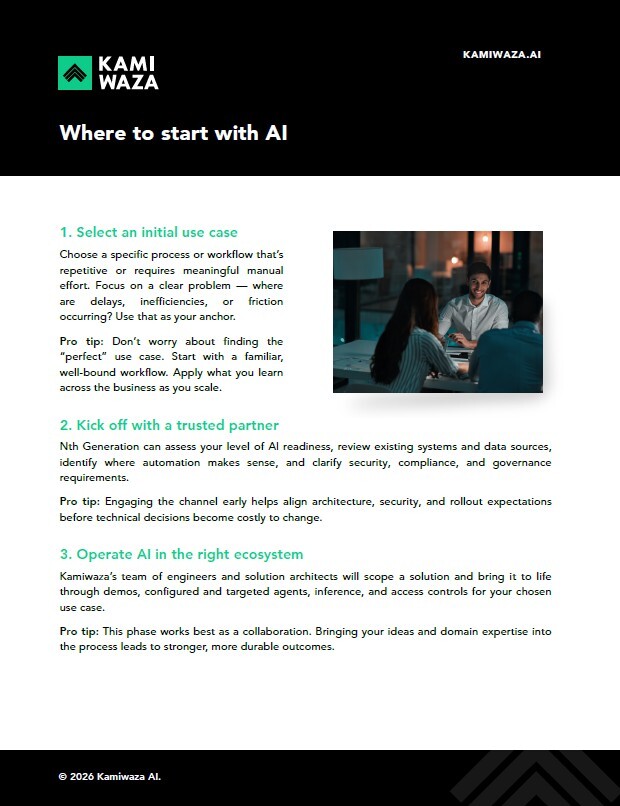
Start with one production workflow. Kamiwaza can help map its context, model, and deployment requirements to an acceptable cost per completed outcome. Learn more at kamiwaza.ai.
Sources
- McKinsey & Company, “The cost of intelligence: How CIOs can manage AI demand at scale,” 2026. Source
- Gartner, “AI Inference Costs Per Agentic Workflow Will Increase More Than Fivefold Through 2028,” August 17, 2026. Source
- Deloitte, “AI tokenomics: A CFO’s guide to governing the AI P&L,” April 22, 2026. Source
- Deloitte Insights, “AI tokens: How to navigate AI’s new spend dynamics,” January 19, 2026. Source