
Stop Moving Data. Start Running AI Where Your Data Lives.

Your enterprise data is everywhere. It is too big, too sensitive, or too regulated to move for AI processing. This “data gravity” blocks your most critical AI initiatives.Kamiwaza’s Distributed Data Engine (DDE) is the core architecture that brings AI to your data. Process information securely across clouds, data centers, and the edge without costly, risky data migrations.

Data Gravity is Killing Your AI Projects

Traditional AI demands the impossible: centralize all your data first. This approach fails because your enterprise reality is distributed.

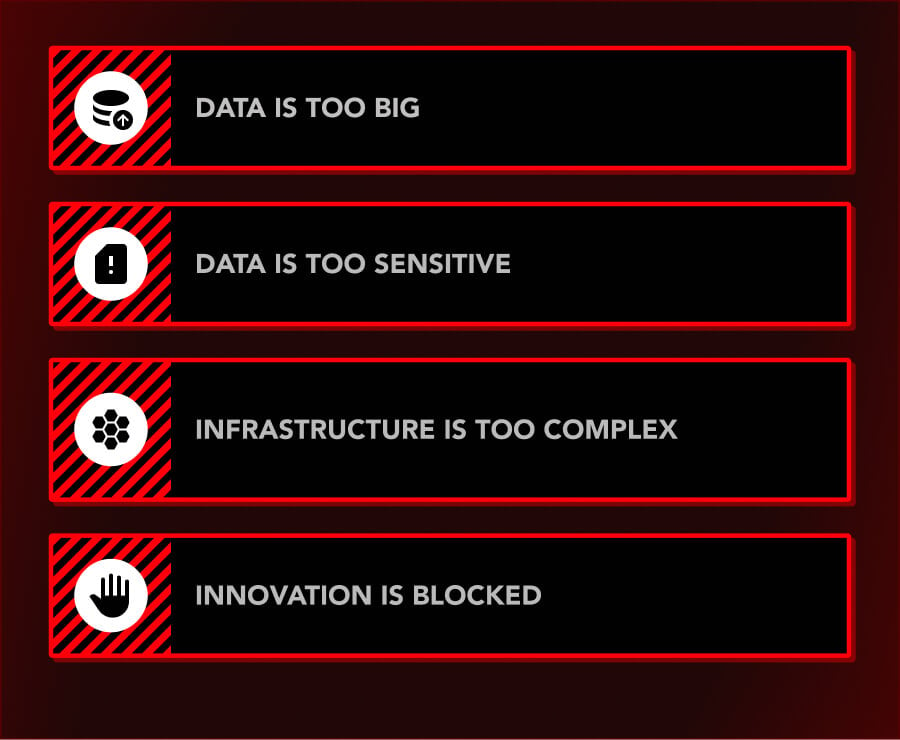
  • Data is too big - Moving petabytes of data across networks is incredibly slow and expensive. Your real time AI needs cause you to get held up on historical analyses.

  • Data is too sensitive - Security policies and regulations like GDPR or HIPAA strictly prohibit moving sensitive customer, patient, or financial data outside secure boundaries.
  • Infrastructure is too complex - Your data lives across multiple clouds, on premise legacy systems, and edge locations. Building and maintaining pipelines to centralize this is an operational nightmare.
  • Innovation is blocked - If you can’t move data to where traditional AI tools run, you simply can’t use most AI services.
 

data-gravity-is-killing-your-ai-projects

Federated Data Access Brings AI to Your Data

Kamiwaza’s DDE fundamentally inverts the traditional model. Instead of data coming to compute, compute goes to the data. Now you can send AI agents to securely query and process data from any database, legacy system, or edge location, even behind firewalls. Our DDE connects to sources across silos and locations, making data practical for AI without migration. You activate your information where it resides. This creates an intelligent fabric across your entire infrastructure.

data-icon

Maintain Data Sovereignty

Your data never leaves its secure environment. The DDE processes it in place, ensuring security and compliance automatically.

execution-icon

Federated Execution

AI queries run intelligently across distributed locations. Only the necessary results are returned, not the raw underlying data.

deployment-icon

Flexible Deployment

Deploy DDE nodes wherever your data resides. This works across different geographies, clouds, business units, or security boundaries.

Orchestrating Intelligence Across Distributed Nodes

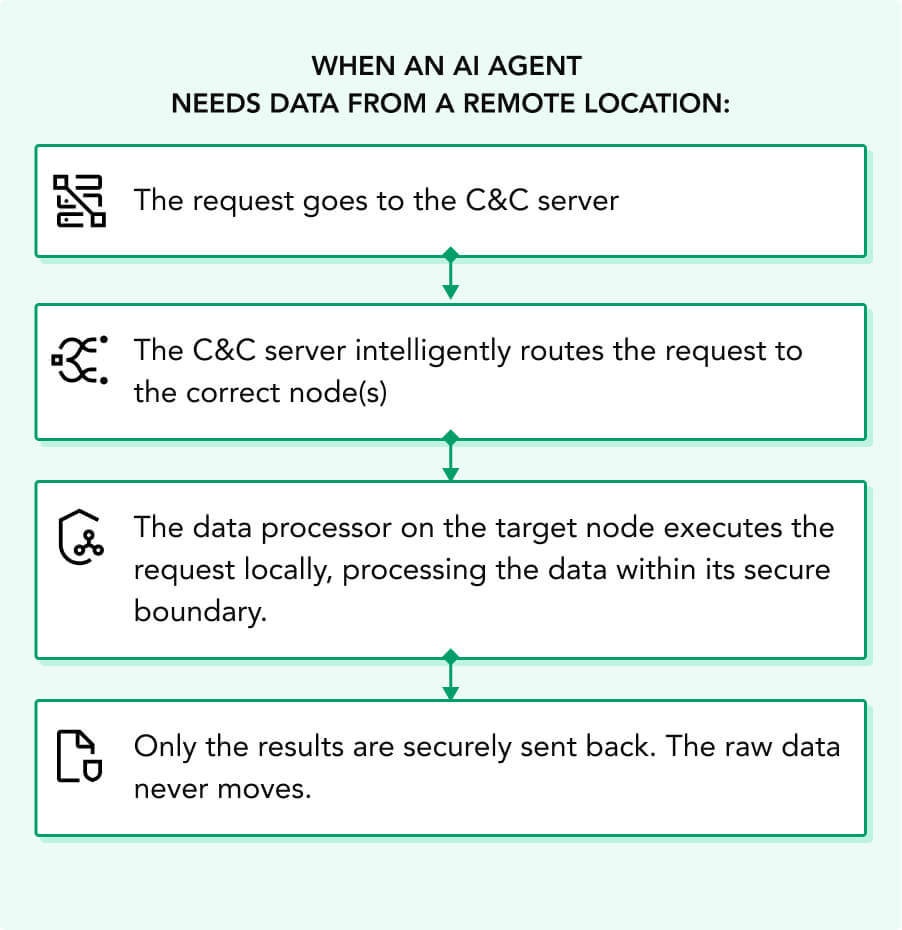
Distributed nodes. Lightweight components deployed wherever your critical data lives (cloud VPCs, on premise servers, edge gateways).

Command and control (C&C) server. The central orchestrator. It knows which nodes exist, what data they can access, and how they connect. It manages communication securely.

Data processors. Specialized AI agents living on each node. They understand the local data and can process it securely in response to requests.

infographic-when-an-ai-agent-needs-data-from-a-remote-location

Unlock AI Without Risking Your Data

Kamiwaza’s DDE fundamentally inverts the traditional model. Instead of data coming to compute, compute goes to the data. Now you can send AI agents to securely query and process data from any database, legacy system, or edge location, even behind firewalls. Our DDE connects to sources across silos and locations, making data practical for AI without migration. You activate your information where it resides. This creates an intelligent fabric across your entire infrastructure.

overcome-data-gravity-icon

Overcome Data Gravity

Eliminate the massive cost, time, and risk associated with moving large datasets.

security-and-compliance-icon

Ensure Security and Compliance

Keep sensitive data within its designated secure environment automatically. Compliance becomes architectural.

rocket_icon

Improve Cost Efficiency

Leverage your existing infrastructure. Avoid spending millions on building and maintaining complex data centralization pipelines.

FAQs About Distributed Intelligence

What Is Data Gravity?

Data gravity is the principle that as data grows in size, sensitivity, and complexity, it becomes increasingly difficult and expensive to move, pulling applications, services, and workflows toward it instead. The more critical a dataset is to the business, the stronger this pull becomes. This isn't just about file size. Movement introduces latency, cost, and risk, especially where compliance and data sovereignty are involved. Consider a manufacturing plant generating 10TB of sensor data daily: centralizing that to a single cloud means transferring 3.65 petabytes annually, creating significant latency, transfer costs, and compliance exposure. This is why traditional “move everything first” approaches to enterprise AI stall. Kamiwaza takes the opposite approach: instead of moving data to AI, we bring AI to where your data already lives.

Why Shouldn’t I Just Centralize My Distributed Data?

Centralizing data from thousands of legacy systems, cloud sources, and edge devices can be expensive and slow. Moving data can also increase the risk of exposure. Furthermore, modern enterprises don’t just have distributed data. They have distributed operations, regulations, stakeholders, and decision-making needs that can’t be centralized. When data lives everywhere but intelligence lives in one place, no amount of bandwidth can solve the mismatch. Rather than forcing data to travel to intelligence, a distributed architecture enables intelligence to flow to data. Instead of fighting the physics of data gravity, it embraces the reality of where information naturally resides.

Are There Solutions That Let Me Use Data From Many Different Sources for Ai Without Moving It?

Yes. With our Distributed Data Engine, Kamiwaza enables federated data access that lets you use data from cloud databases, legacy systems, and edge devices without moving it. Kamiwaza securely connects to every data source in your enterprise: private servers, public clouds, laptops, cameras, and other edge devices.

What Are Some Common Implementation Patterns for Distributed Intelligence in the Real World?

Common patterns for distributed intelligence include:

  • The hub-and-spoke pattern: This works well for retail chains, branch networks, and distributed facilities. Intelligence concentrates at regional hubs that coordinate local nodes. 
  • The mesh pattern: This suits peer-to-peer scenarios where nodes need direct coordination. Manufacturing lines might form an intelligence mesh where each station coordinates with adjacent stations. Quality issues identified at one station immediately influence upstream and downstream operations.
  • The hierarchical pattern: This fits organizations with clear operational hierarchies. A military deployment might layer intelligence from individual sensors through unit-level analysis to command-center strategy. Each level processes information appropriate to its decision-making needs.
  • The fog pattern: This enables dense edge deployments where collective intelligence emerges from many small nodes. Smart city deployments might use thousands of traffic sensors that collectively optimize flow without central control. Individual sensors possess limited intelligence, but their collective behavior exhibits sophisticated optimization.
What Are the Components of a Distributed Intelligence Architecture?

A distributed intelligence architecture consists of four interconnected layers that work together to create a unified intelligence fabric.

  • The cognitive edge transforms every endpoint into an intelligent node. This means using the right intelligence for each location’s needs, rather than deploying powerful hardware everywhere. A retail store’s edge node might run customer behavior models and inventory optimization algorithms. A manufacturing sensor might run anomaly detection and predictive maintenance models. A hospital device might process patient vitals and alert predictions.
  • The aggregation layer creates regional or group intelligence hubs that synthesize insights from multiple edge nodes, while respecting boundaries. These hubs centralize patterns, insights, and decisions, not raw data. A regional retail hub might identify purchasing trends across stores without accessing individual transaction details. A manufacturing hub might coordinate production across facilities without exposing proprietary process data.
  • The orchestration layer coordinates intelligence across all nodes and hubs, ensuring the right models run in the right places. This layer understands the capabilities of each node, the requirements of each workload, and the constraints of each environment. It dynamically routes intelligence requests, balances computational loads, and ensures consistent operations across the distributed fabric.
  • The governance layer maintains security, compliance, and consistency across the entire architecture. This isn’t a separate system bolted on top: it’s woven into every component. Every node enforces access controls. Every communication respects encryption requirements. Every operation logs appropriately for audit.
How Can a Distributed Intelligence Architecture Improve Performance?

A distributed intelligence architecture delivers performance improvements across multiple dimensions:

  • Latency reduction comes from processing data where it originates. Real-time decisions happen in milliseconds, not seconds. A manufacturing defect triggers immediate response. A security threat generates instant alerts. A customer receives immediate attention.

  • Bandwidth optimization eliminates unnecessary data movement. Only insights and models traverse networks, not raw data. A video analytics system might process thousands of hours of footage locally, transmitting only identified events. Network costs plummet while capability expands.
  • Infrastructure efficiency maximizes existing investments. That five-year-old server becomes an edge intelligence node. Those branch office systems gain AI capabilities. Legacy infrastructure transforms into distributed intelligence fabric without replacement.
  • Operational resilience emerges from distributed redundancy. No single point of failure can disable the entire system. Local nodes continue operating during network outages. Regional hubs provide backup for failed nodes. The architecture self-heals and self-optimizes continuously.
How Can You Route Intelligence in a Distributed Architecture?

In traditional architectures, routing is about moving data. In a distributed intelligence architecture, routing is about moving capabilities. Kamiwaza provides this through our Inference Mesh.

For example, when a European manufacturer needs to analyze production quality, the system doesn’t route European data to American servers. Instead, it routes appropriate quality analysis models to European nodes where the data resides.

This model distribution happens dynamically based on multiple factors:

Data locality determines where models deploy. This choice is based on where relevant data resides. Models follow data, not the other way around. This eliminates data movement, reduces latency, and maintains compliance by default.

Resource optimization balances computational loads across the distributed fabric. If one node approaches capacity, the architecture can route overflow to nearby nodes or temporarily deploy additional models to handle peaks. Resources become fluid, flowing where needed most. With Kamiwaza, routing is locality-aware and policy-aware, not just load-aware.

Security boundaries ensure models and data never cross unauthorized boundaries. A model cleared for financial data won’t accidentally process healthcare records. A model authorized for one geographic region won’t process data from another. Security becomes architectural, not procedural. Kamiwaza is designed to support GDPR, HIPAA, and air-gapped federal environments.

Are There Solutions That Let Me Use Data From Many Different Sources for Ai Without Moving It?

Yes. With our Distributed Data Engine, Kamiwaza enables federated data access that lets you use data from cloud databases, legacy systems, and edge devices without moving it. Kamiwaza securely connects to every data source in your enterprise: private servers, public clouds, laptops, cameras, and other edge devices.

How Is Complexity Managed in a Distributed Intelligence Architecture?

Distributed systems are inherently more complex than centralized ones. A distributed intelligence architecture manages complexity with:

  • Autonomous adaptation that enables each node to operate independently when needed. If network connections fail, edge nodes continue processing with local models. 
  • Synchronized state management that ensures consistency without centralization. Updates propagate efficiently without requiring central coordination. Conflicts resolve automatically based on predefined policies.
  • Intelligent monitoring that provides visibility without overwhelming operators. The architecture monitors itself, identifying bottlenecks, predicting failures, and suggesting optimizations. Operators see a unified view of the distributed system without drowning in individual node metrics.
planet

Build Your AI Future on Your Distributed Reality

Stop letting data gravity dictate your AI strategy. Discover how Kamiwaza’s Distributed Data Engine enables powerful, secure AI across your entire enterprise, right where your data lives.