
The Audit Trail: Keeping Humans in the Loop

From Chatbots to Agents: A Different Kind of Risk
The enterprise AI story has moved through several chapters. AI started as a search and recommendation engine, became a chatbot, then a copilot embedded alongside human work. The current includes AI increasingly operating as an agent: acting autonomously across systems, executing multi-step processes, and triggering consequential outcomes without requiring a human to review each step. According to McKinsey’s 2025 State of AI research, 88 percent of organizations now use AI in at least one business function, 23 percent are actively scaling agentic AI systems, and another 39 percent are experimenting with them.1 When AI stops advising and starts acting, the accountability requirements change with it.
The Audit Trail as a Strategic Asset
The difference between an AI assistant and an AI agent is not just capability, but includes consequence. When an assistant prepares a vendor risk summary, a human reads the output, decides what to do, and takes action. When an agent manages that same process, it retrieves the vendor record, pulls recent contract and compliance data, cross-references applicable policies, generates a risk assessment, and routes any exceptions for approval. Same domain, very different accountability surface. NIST has made this point directly in its work on agentic AI: users need greater visibility into the tool usage, evidence, and multi-step logic behind agentic decisions, and organizations need to constrain and monitor the scope of agent access in deployment environments.2
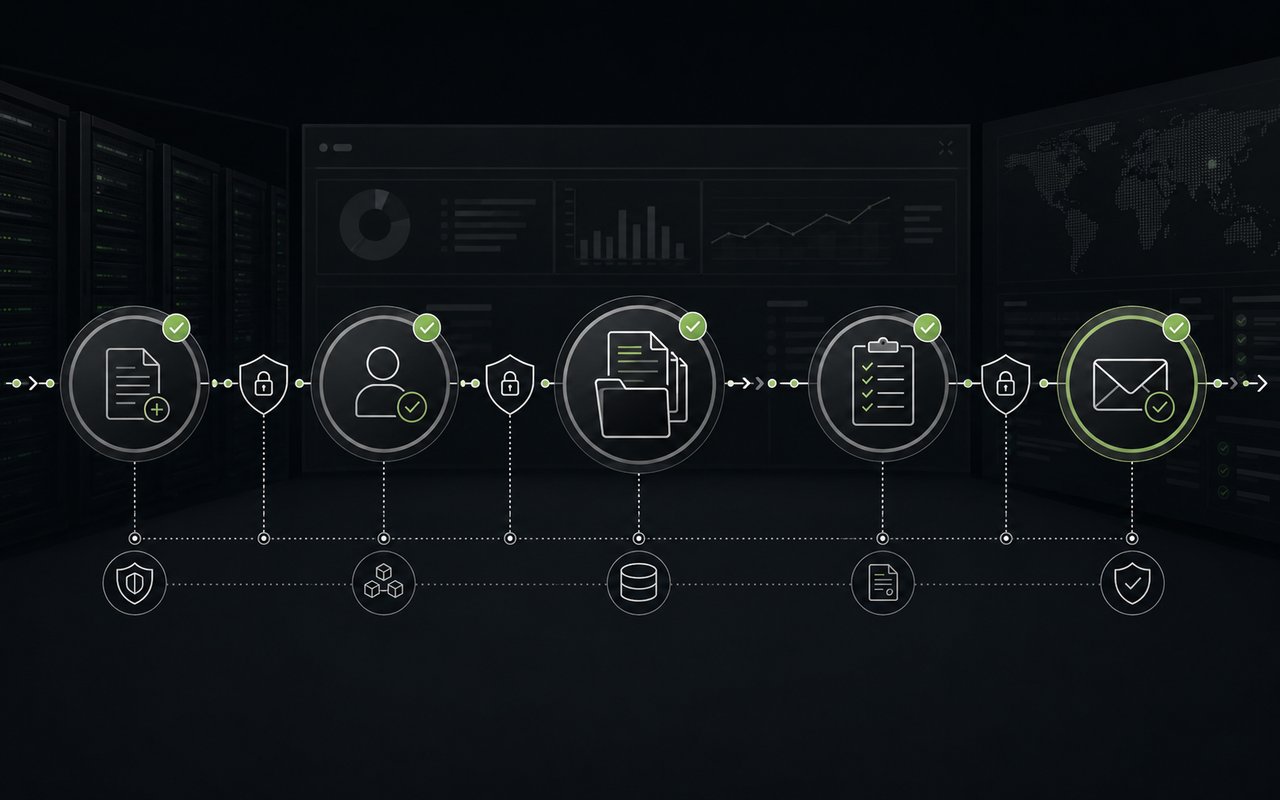
For AI, an audit trail is not just a log file or a timestamped event stream. It is the operating record that connects an action to the initiating user, the accessible data, the governing permissions, the evidence consulted, the workflow steps taken, and the resulting outcome. Without that chain, an enterprise may know that something happened, but not whether it happened appropriately.
That gap matters because trust in AI is rarely lost at the model layer alone. It is lost at the point where someone asks a very practical question: why did the system do that? If the answer is vague, incomplete, or impossible to reconstruct, the organization does not have an operational AI capability; it has an opaque source of risk. NIST’s AI Risk Management Framework treats accountability, transparency, explainability, and governance as core trustworthiness concerns, not optional enhancements.3
In order to provide this level of information, accountability must be an architectural requirement, not an afterthought. Organizations building serious AI operations are asking how their platforms enforce entitlement boundaries, trace evidence to decisions, and surface the information a human reviewer would need. Those are design questions, and the answers have to be built in from the start.
When Accountability Has Legal Weight
The governance issue becomes sharper in decisions that touch fairness, rights, or regulated obligations. In hiring, the EEOC has made clear that AI can be involved in recruiting, screening, video interview analysis, promotion decisions, pay decisions, and termination-related decisions.4 These are decisions that can trigger discrimination concerns if an employer cannot explain what influenced the outcome or whether the process treated people lawfully.
The same principle applies in lending. The CFPB has stated that creditors using complex algorithms must still provide specific reasons for adverse actions under ECOA and Regulation B.5 A technical inability to explain a decision does not remove the obligation to justify it. The discipline of explanation is built into the consumer protection logic itself, because organizations that know they must explain decisions are less free to conceal discriminatory or poorly grounded outcomes inside a black box.
Recent enforcement action reinforces the broader lesson. In late 2024, the FTC took action against IntelliVision over claims that its facial recognition software was free of gender and racial bias, alleging the company lacked evidence to support those claims.6 The implication for enterprise buyers is direct: assertions about fairness or accountability need evidence behind them. Governance language is not a substitute for demonstrable controls.
Human-in-the-Loop Is a Design Choice, Not a Checkbox
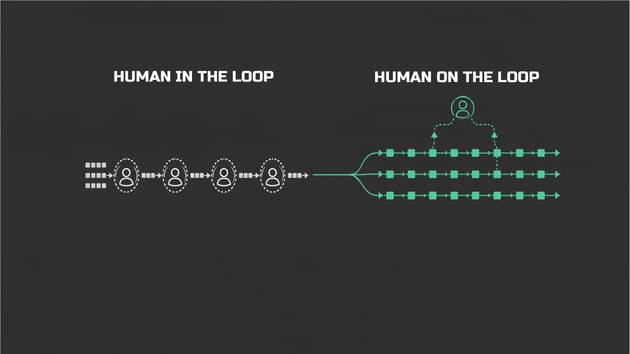
Keeping humans in the loop should be understood less as a symbolic approval step and more as a design principle for accountable execution. A meaningful human-in-the-loop model does not require a person to manually repeat every action an AI system performs. It requires the system to preserve the information a responsible human would need in order to authorize, review, challenge, or defend what happened.
In practice, that means preserving provenance, maintaining evidence links, scoping access correctly, and making interventions possible at the right decision points. NIST’s work on agentic AI evaluation emphasizes evidence support, completeness, and sufficiency rather than output fluency alone.2
Five Characteristics of a Strong AI Audit Trail
A strong AI audit trail has five characteristics.
-
It ties every agent action to a human source of authority. The organization should be able to identify who initiated the workflow, on whose behalf the system acted, and what permissions applied at that moment.
-
It preserves evidence, not just outcomes. It should be possible to inspect what documents, records, policies, or data sources materially informed a recommendation or action.
-
It records workflow context. An isolated answer is not sufficient when the system performed a sequence of retrieval, reasoning, tool use, and execution steps. Decision traceability requires the chain, not just the endpoint.
-
It supports review and intervention. Human oversight is most useful where risk is highest: approvals, exceptions, irreversible actions, and decisions with legal, financial, or employment consequences.
-
It creates a system of record that stands up after the moment has passed. The real test is whether compliance, security, legal, or business leadership can reconstruct what occurred days or months later with enough clarity to act on it.
Architecture Before Process
When implementing agentic AI, many organizations discover that the governance problem is architectural before it is procedural. If an agent operates across systems without clear entitlement boundaries, if evidence is pulled into context without disciplined traceability, or if logs capture activity without meaning, then post hoc oversight becomes expensive and unreliable. The organization ends up with fragments of accountability rather than accountability itself.
Organizations running Kamiwaza can answer the governance questions that most enterprises currently cannot. The platform scopes what a user - and the agents acting on their behalf - can reach within a given workspace. Kamiwaza emits structured audit events for service-level actions, capturing the initiating user, session, request correlation ID, and outcome - written to a durable, append-only audit log that compliance, security, and legal teams can reconstruct from. Compliance, security, and legal teams gain a durable audit record for AI actions, not just a log of events. The point is not simply to let AI participate in work, but to let it do so in a way that leaves the organization more accountable, not less.
Speed and Accountability Are Not a Tradeoff
That framing matters because it avoids a common mistake in AI governance conversations. The objective is not to slow every workflow down with ceremonial approvals, nor is it to accept opaque autonomy in the name of speed. The better design goal is to let AI move quickly inside a governed operating model where actions are attributable, evidence is inspectable, and human oversight appears where consequence requires it.
For CIOs, CISOs, and CAIOs, this is already a buying and architecture question, not a policy one. Organizations are facing regulatory inquiries, internal audits, and legal challenges today that require them to explain not just what their AI systems did, but why, and under what authority. The inability to answer those questions is not a future risk. It is a present exposure.
Accountable AI is not aspirational. The standard is clear: every consequential AI action must be attributable to a human authority, grounded in inspectable evidence, and contained within a governed operating model. Organizations that build to that standard will not just satisfy auditors and regulators. They will be the ones their customers, partners, and regulators trust to scale AI further.
Learn more about Kamiwaza's security and compliance capabilities.
References
1. McKinsey & Company, The State of AI: Global Survey 2025.
2. NIST, CAISI Issues Request for Information About Securing AI Agent Systems; NIST, Building Evaluation Probes into Agentic AI.
3. NIST, AI Risk Management Framework.
4. EEOC, Employment Discrimination and AI for Workers.
5. CFPB, Consumer Financial Protection Circular 2022-03.
6. FTC, IntelliVision Technologies enforcement action.