

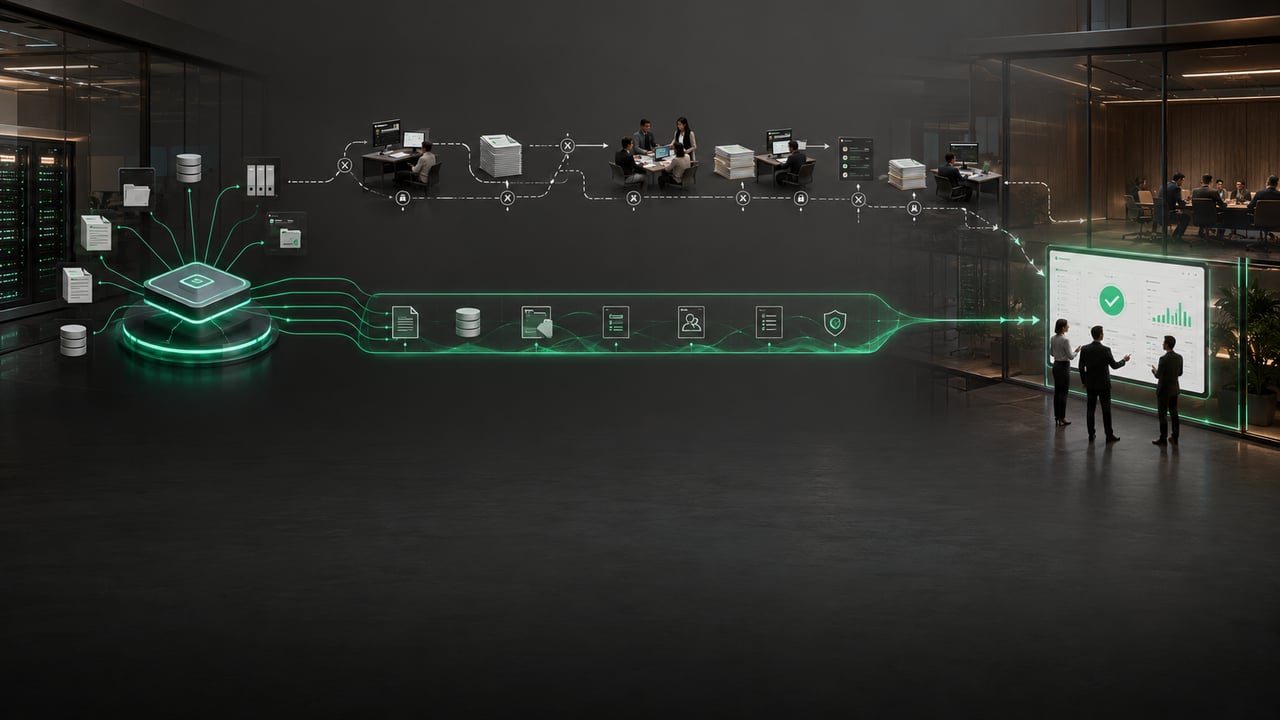
Rethinking Enterprise AI Time to Value

How long should it take to get value from enterprise AI? Most evaluations answer with an installation timeline, because installation is the milestone a vendor can commit to and a procurement team can verify. Value arrives on a different schedule. A system can be running in days and still be months away from producing anything the business would recognize as a return, because the return depends on how quickly the system learns enough about the organization to complete real work.
Value in this context deserves a concrete definition, since the word covers too much ground on its own. Enterprise AI produces returns in three broad categories: improving the customer experience, accelerating actions and decisions, and reducing the cost of producing work. An agent that resolves routine service cases in hours rather than days improves the customer experience. A system that assembles the full context for a credit or coverage decision in minutes accelerates the decision itself. An agent that reconciles accounts or processes documents without adding headcount reduces the cost of producing that work. All three categories share the same requirement: the system has to complete work at acceptable quality, not merely answer questions about it. Time to value measures the distance between contract signature and the first of those outcomes delivered reliably.
Time to Deployment and Time to Value Are Different Measurements
Enterprise software buying habits were formed in an era when the purchase was a tool a person would use. Buyers learned to evaluate implementation timelines, integration effort, and training schedules, all of which measure how long it takes for software to become available. Agentic AI changes what the buyer is paying for. The purchase is an outcome the system produces, which means the meaningful milestone is the first outcome delivered at acceptable quality, and the meaningful trend is how quickly quality and coverage improve from there.
Research reflects the gap between availability and value. Deloitte's 2026 State of AI study finds that initial pilots deliver learning and capability-building quickly, while scaling to strong returns typically takes six to twelve months or longer. The pattern behind that lag is consistent. The pilot proved the system could reason over a clean, well-understood slice of the business. The long middle of the timeline went to connecting that reasoning to the systems, policies, and exceptions that define how the organization actually operates.
What Meaningful Outcomes Require: Connected Data With Context
Each of the three value categories rests on the same foundation. An agent cannot improve a customer's experience, accelerate a decision, or take cost out of work unless it can reach the relevant data across the systems that hold it, and unless it understands what that data means in the organization's own terms. Meaningful outcomes require connected data with context, and the timeline of any AI implementation is largely the story of how those two requirements get satisfied.
Connecting the data is the first place schedules stretch. Enterprise data lives across dozens or hundreds of systems in inconsistent formats, and many organizations delay their AI programs because they believe that “messy data” must first be cleaned, normalized, or migrated before an agent can use it. Architectures that read data where it lives, in the format it already takes, remove much of that perceived prerequisite and with it a substantial share of the timeline.
Access alone does not produce reliable action, though. Before an agent can act dependably, something has to encode how the organization works: how a customer relates to a contract, which policy governs a document, who is entitled to see what, and which precedents shape how edge cases get resolved. Most implementations pay for that context in engineering time. Teams hand-build retrieval pipelines, write and rewrite prompts that describe business rules, and maintain mapping layers that go stale as the organization changes. None of that work is visible in a demonstration, which is why so many projects appear nearly finished for months while the completion date keeps moving.
Automated ontology building changes the economics of that work. When the context layer is derived from signals the organization already produces, such as system relationships, entitlements, and policies, and is maintained continuously as those signals change, months of manual encoding compress into a much shorter window. Kamiwaza builds and maintains that context layer automatically as agents work across an organization's data, wherever that data resides, which addresses both requirements through the same architecture.
Value Accrues After Deployment
The second reframing follows from the first. In agentic systems, deployment marks the beginning of value creation rather than the end of the project, because the system improves through execution. Each completed task refines how the agent handles the next one. Each exception surfaced to a human and resolved becomes part of the operating context. Decision quality, coverage of edge cases, and the share of work completed without intervention all improve over time in a well-architected system, and they improve faster when the context layer captures what execution teaches.
McKinsey's State of AI research points at the same dynamic from the organizational side. The strongest correlate of enterprise-level financial impact from AI is fundamental workflow redesign, which high performers are nearly three times as likely to undertake as everyone else. Redesigning a workflow around an agent only pays off if the agent keeps getting better inside it, because the redesigned workflow depends on the system absorbing a growing share of the work.
Buyers should therefore weigh the rate of improvement as heavily as the speed of installation. Useful diligence questions include how quickly the system improves once running, what mechanism turns completed work into better future decisions, and whether the context the system accumulates remains an asset the enterprise owns and governs.
How Time to Value Informs Build Versus Buy
The framework above applies to any AI implementation, whether the capability is built internally, bought as a platform, or assembled with a partner, because every path faces the same three sources of delay: connecting to data, encoding how the business works, and governing what the system is allowed to do. Build versus buy enters the conversation only as a second-order question, since the main difference between the paths is how they distribute that work. An internal build assigns the context phase to your own engineers and asks them to maintain it indefinitely. A platform purchase shifts the question to whether the vendor's approach to context genuinely automates the work or simply relocates it into a services engagement.
A CFO comparing options can put numbers on the same framework: the cost of the context phase under each path, the financial worth of reaching first outcomes earlier in each of the three value categories, the ongoing burden of keeping context current as the business changes, and the effect of a longer timeline on organizational support. Initiatives that produce completed work within a quarter tend to retain their sponsors and their budgets. Initiatives that spend most of a year building context often lose both before the value arrives.
An IT leader running the same evaluation should press vendors and internal teams alike on the questions that installation timelines hide. Who encodes the business logic, and how long has that taken in comparable deployments? What happens to that encoding when the organization reorganizes, changes a policy, or adds a system? Which parts of the context layer require specialists to maintain, and are those specialists available?
Questions Worth Asking Your Team
Before the next AI initiative reaches a signature, these questions will show whether the evaluation measures value or merely availability.
- When we scope an AI initiative, do our timelines distinguish time to deployment from time to first completed outcome, and which one do we report to the executive team?
- Which of the three value categories is each initiative targeting, improved customer experience, accelerated actions and decisions, or reduced cost of producing work, and how will we measure the first delivered outcome in that category?
- In our last AI project, how much of the schedule went to connecting data and teaching the system how the business works, and was any of that work reusable for the next project?
- If a policy, entitlement, or system relationship changes tomorrow, how long before our AI reflects it, and who carries that maintenance burden?
- Can we describe the mechanism by which our AI systems improve after deployment, and are we measuring that improvement in decision quality and cycle time rather than usage?
The organizations getting durable value from enterprise AI are not the ones that installed fastest. They are the ones that shortened the path to a system that understands the business, and then kept that understanding current as the business changed. Context, once built and continuously maintained, becomes an asset that every subsequent initiative inherits, which is why time to value, asked rigorously, improves nearly every other decision in the AI portfolio.