
Kamiwaza 1.0: Collaborative Intelligence Where Data Lives
Enterprise AI has largely been stuck at the pilot stage. Most organizations have run successful proofs of concept, but many have struggled to move those pilots into the connected, day-to-day operations where the business actually runs. The challenges are varied, and no single solution addresses all of them, but a few recurring areas stand out among the many enterprises working through this transition:
- Data availability and quality, which includes pulling together information that lives across disparate systems that were never designed to be queried together.
- Operationalizing AI and finding the right use cases, which often requires reworking existing workflows to include agents alongside the people who already run them.
- Measuring the value of what has been deployed, which is where the pressure to justify continued investment tends to concentrate.
These are only a few of the areas where enterprises encounter friction, and the list is far from exhaustive. Kamiwaza has been working on the disparate data challenge for some time, building the Distributed Data Engine, Inference Mesh, and the Context Manager that let AI reason across systems without forcing the business to move its data.
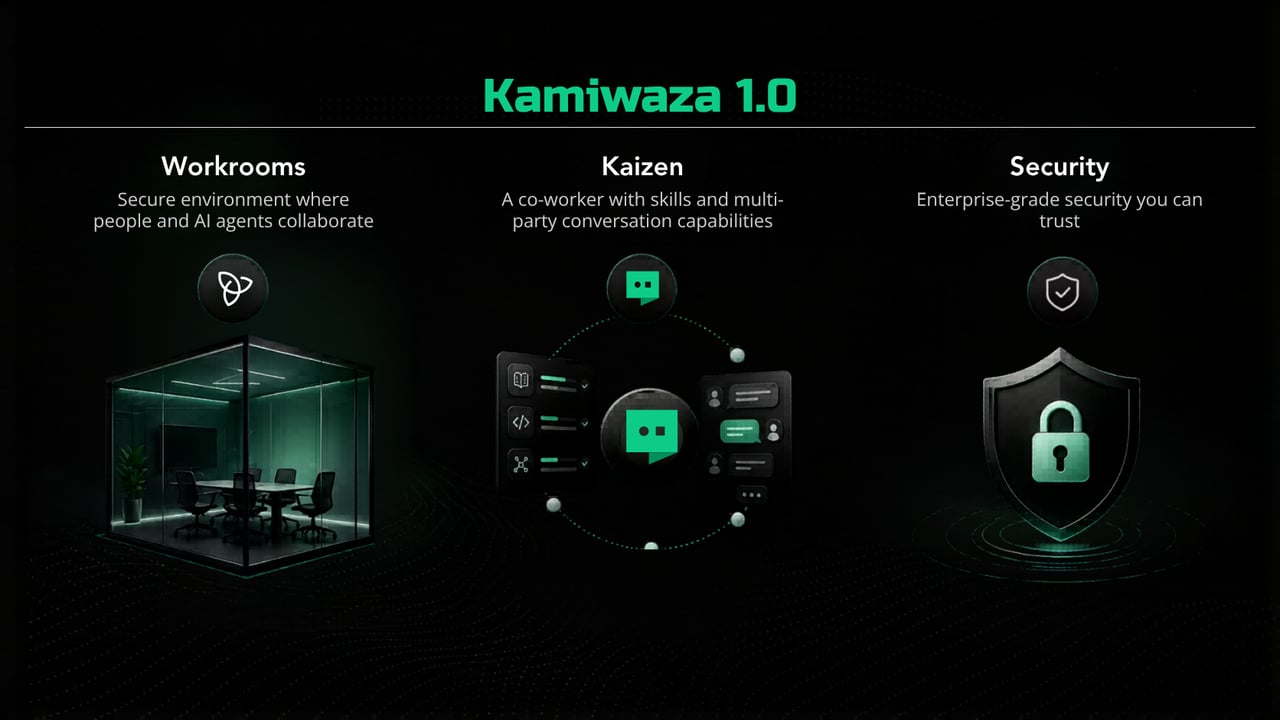
Today, I’m proud to announce Kamiwaza 1.0, which extends three features to the platform: Workrooms, an expanded Kaizen (Kamiwaza’s flagship agent), and a Chainguard-hardened foundation.
The scaling gap
The scale of the problem is well documented at this point. MIT Sloan's 2025 research into generative AI deployment found that roughly ninety-five percent of pilots fail to graduate into production, and a March 2026 survey of enterprise technology leaders put a finer point on the pattern, noting that while seventy-eight percent of enterprises now have AI agent pilots underway, only fourteen percent have successfully scaled an agent to organization-wide operational use.
The reasons are practical. Workflows that made sense in a siloed organization do not translate cleanly to shared execution. Reasoning across multiple systems is impossible when data remains fragmented in silos. And AI that cannot work the way people work together cannot be trusted with the parts of the job that carry real risk.
Kamiwaza Workrooms: secure spaces where teams and their AI operate together
Workrooms are how enterprises operationalize AI in practice. They are secure environments where people and AI agents collaborate on real work, and the room itself enforces the governance and security that keep sensitive information from leaking across teams, functions, or projects. Governance is not the thing the room works around. The room is the mechanism through which governance is actually enforced, which is what makes shared execution possible in the first place.
Consider a corporate development team working through a signed acquisition, a coordination problem familiar to anyone who has lived inside an integration office. Human resources plans around staffing and benefits, finance plans around operating assumptions, and legal tracks obligations and review steps, all in parallel and all under the same sponsor. Each function needs visibility into the others to coordinate, without inheriting the access patterns that belong to the other groups.
Within a Workroom, the data, agents, credentials, and the conversations are governed inside the boundary of the room itself, with membership, ownership, and sharing all made explicit. Workrooms use Relationship-Based Access Control (ReBAC) to manage permissions based on the user's actual connection to the data and task, rather than just their job title.
Kaizen: an operational coworker
Kaizen is Kamiwaza's flagship agent, and the 1.0 release represents a substantial step forward in what it can do for the business. While doing more than answering questions, Kaizen performs tasks for its users and possesses domain-specific skills for the areas in which it operates. Inside a Workroom, Kaizen participates in the conversation with everyone in the room at the same time while keeping each participant's individual permissions in mind, which makes it a collaborative member of the team rather than a tool each person has to query on their own.
Every step Kaizen takes runs under the permissions the enterprise's security model already enforces and leaves an auditable trail behind it. This capability is where organizations often see the first tangible returns, as Kaizen is the primary interface for many business users and a benchmark for determining if the AI investment is delivering value.
A hardened foundation
Kamiwaza 1.0 operates on Chainguard-hardened container images, featuring a SLSA Level 3 compliant build pipeline and verified software bills of materials that accompany every release. This means that the infrastructure carries attested evidence of its supply chain, starting from the base image. For security and compliance teams, attested infrastructure at the image layer changes the starting point of a compliance conversation. The review begins with evidence already in hand, creating the posture that allows production AI conversations to advance.
Faster access to data, without giving up compliance
Kamiwaza strives to give people faster access to the data they need to do their jobs, in the places they work, without asking the enterprise to compromise its governance and compliance posture. The platform has always enabled AI to reason across systems using the Distributed Data Engine and Context Manager. Kamiwaza 1.0 advances this core mission into the daily operations of the business. It brings secure collaboration through Workrooms, a customizable coworker in Kaizen, and attested infrastructure via the Chainguard-hardened foundation. This combination ensures the speed advantage compounds without the compliance costs increasing.
You can learn more about the features we released today and see demos of it in action on our website.
Citations and sources
- MIT Sloan, research on generative AI pilot deployment rates, 2025.
- Enterprise technology leader survey on AI agent pilot and scaling rates, March 2026.
- Chainguard product documentation on SLSA Level 3 pipelines, verified SBOMs, and hardened container images.