
What’s New in Kaizen: Enterprise Capabilities for Enterprise AI

Enterprise AI is reaching a critical inflection point where organizations, having completed initial pilots and tests with copilots, are now focused on the practical deployment of AI that fully participates in real work, operates within existing systems, and adheres to necessary enterprise controls. This strategic evolution echoes the shift described by McKinsey, which notes that while early generative AI systems were largely reactive, modern agents must possess the capacity to understand complex goals, break work into subtasks, interact with people and systems, and execute actions across workflows [1].
It is this category of proactive, workflow-executing agents that Kaizen, Kamiwaza’s flagship agent, is designed to serve. Going beyond simple information retrieval, Kaizen is a conversational agent capable of participating directly in sophisticated workflows, leveraging domain-specific skills, and operating with robust context built from the relationships across all enterprise data, systems, teams, and tasks, all while maintaining the controls and architecture expected in enterprise environments.
An Agent That Participates in Workflows
Kaizen is built for individuals and teams, integrating directly into Workrooms. It is more than a chatbot; it is an agent capable of executing secure, multi-step actions in response to natural language commands.
That distinction shows up in the kinds of work Kaizen is meant to support. Users can analyze financial data, review contracts, discuss strategy, and synthesize responses from multiple systems while remaining inside the enterprise perimeter. In practice, that means the interaction does not stop at retrieval or summarization. Kaizen can help move work forward.
Within Workrooms, Kaizen also supports session sharing, so users in the same Workroom can collaborate together around a shared working session. That gives teams a way to review outputs, build on the same line of inquiry, and keep work coordinated without fragmenting the interaction across disconnected individual sessions.
For IT leaders, the benefit is straightforward: a conversational interface is more useful when it can connect to operational workflows instead of creating another disconnected tool surface.
Domain Skills Without Custom Code
Kaizen can be equipped with domain-specific skills, allowing teams to align the agent to the specific tasks and workflows of a function without custom code.
This approach offers two main advantages: it ensures the agent understands the specialized vocabulary and recurring tasks of the domain, and it significantly reduces the engineering effort required for organization-wide utility.
McKinsey has observed that vertical, function-specific AI often stalls due to the need for excessive custom development and technical components.[1] Kaizen’s skills model addresses this friction, offering organizations a faster path from general AI capability to tangible business utility.
Context Built From Living Ontologies
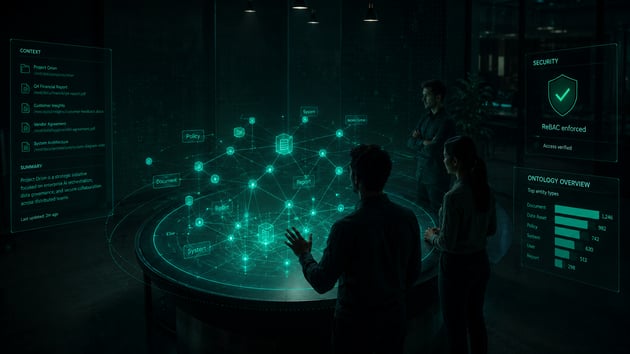
Kaizen’s contextual intelligence is powered by the Kamiwaza Context Manager, which generates a living ontology across the entire enterprise data landscape. This dynamic framework enables Kaizen to understand how data interconnects across various systems, teams, and workflows, moving beyond the limitations of isolated repositories.
While standard AI tools often retrieve simple answers from single sources, Kaizen interprets the nuanced meaning of data within a broader web of relationships. It maps critical attributes such as data ownership, the specific processes it supports, its connection to other records, and the governing policies that shape its use.
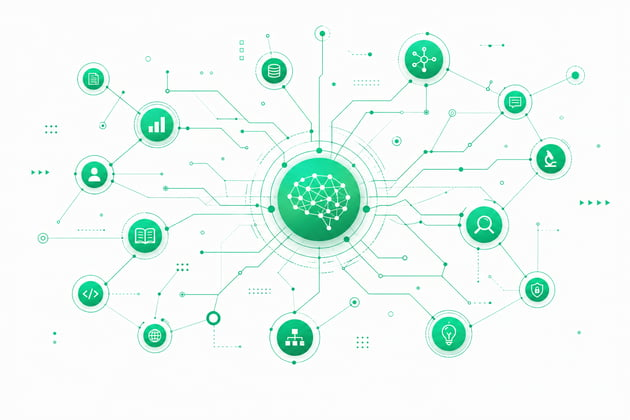
By leveraging this deep relational understanding, Kaizen provides highly accurate answers to complex, cross-domain questions and effectively participates in sophisticated workflows that span multiple systems and sources.
Secure Operation Inside Enterprise Boundaries
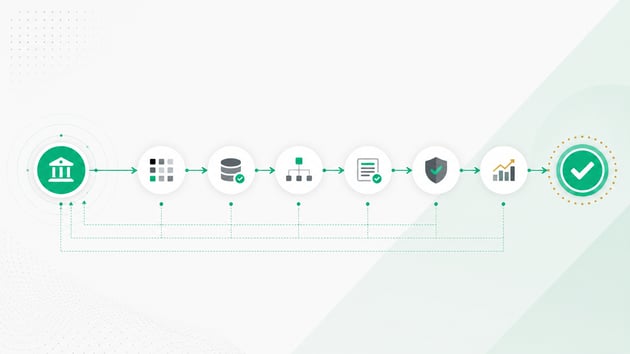
Kaizen operates entirely within enterprise controls and runs behind the firewall, seamlessly connecting to both on-premises and cloud systems without requiring months of custom integration. Designed for regulated and security-conscious organizations, every Kaizen action is governed by strict permissions, full auditability, and enterprise-grade reliability, ensuring that all activity remains grounded in existing internal systems.
As part of the broader Kamiwaza platform, Kaizen also benefits from Inference Mesh, which extends its ability to work across distributed data and distributed inferencing within enterprise environments. For regulated or security-conscious organizations, that combination supports a cleaner operating model in which Kaizen can participate in workflows while remaining bounded by permissions and visible through a full audit trail.
Kaizen: Operationalizing Enterprise AI Workflows
Kaizen is the direct operational interface for the Kamiwaza platform. It moves beyond a purely conversational role to take multi-step actions, apply domain skills, and leverage enterprise-wide context to participate directly in secure workflows. For organizations evaluating enterprise AI, the essential question is whether an agent can truly complete work in a way that fits the business, understands the domain, and adheres to strict enterprise controls. This is the precise role Kaizen is designed to fulfill within Kamiwaza 1.0.
Watch Kaizen in action within a Workroom and learn more about the Kamiwaza.
Citation Footers:
- McKinsey, “Seizing the agentic AI advantage,” June 13, 2025
- McKinsey, “Building the foundations for agentic AI at scale,” April 2, 2026