

How Kamiwaza works: A technical reference for IT teams
How the stack fits together
Kamiwaza is a secure orchestration layer that sits above your existing infrastructure. Nothing is replaced, nothing is extracted. AI agents query data in place, accessing mainframes, policy admin platforms, document stores, email systems, and carrier portals without moving data or crossing your security perimeter.
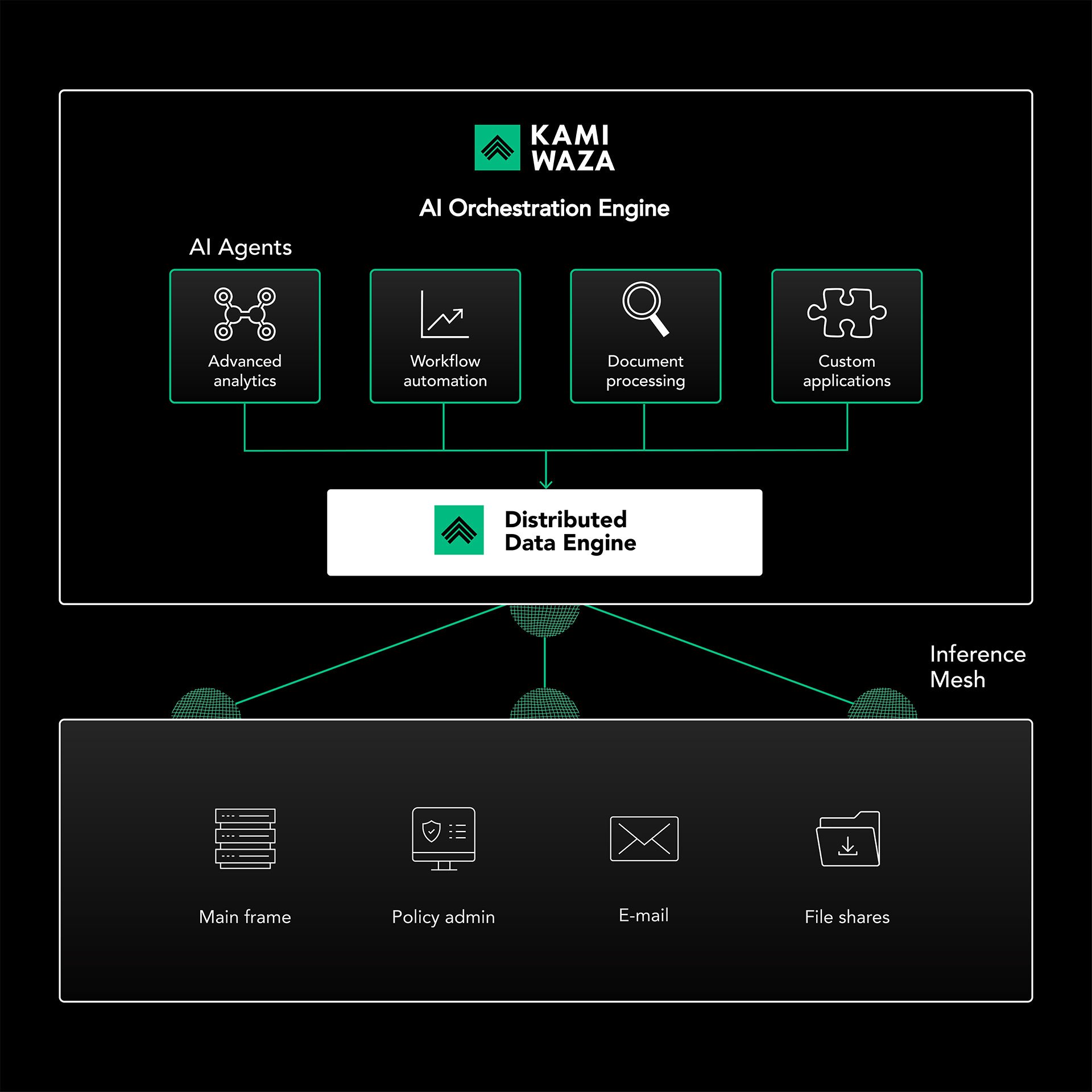
The three layers interact as follows: AI agents in the top layer formulate prompts via the orchestration layer. The orchestration layer routes those queries to the appropriate data source, applies the user’s relationship-based access control (ReBAC) permissions to filter what can be returned, and assembles the result. Data never leaves its origin system.



In-place data inferencing: Your data stays where it is
Kamiwaza connects to systems of record via lightweight connectors — no agents installed on the data source, no extraction pipeline, no copy of your data stored elsewhere. Each connector authenticates using your existing credentials and access controls.
What connects
Mainframes and legacy systems
COBOL, IMS, DB2, VSAM. Kamiwaza’s connectors read structured and semi-structured mainframe data without requiring a middleware layer
Policy administration platforms
Duck Creek, Guidewire, Majesco, and custom systems via REST, JDBC, or direct database connection
Document repositories
SharePoint, network file shares, carrier portals, email attachments. Documents are processed in place using visual language models, no ingestion into a vector database
Real-time feeds
ISO rating data, carrier APIs, third-party enrichment sources. Kamiwaza queries these on demand rather than pre-loading
What doesn’t happen
No data lake
There’s no central repository where your data is copied or consolidated
No transformation prerequisite
Kamiwaza works within existing data formats. There’s no ETL pipeline to build before you can start
No migration window
Connectivity is additive. Existing systems continue to operate normally
Living ontology: Business context, dynamically maintained
Traditional AI deployment requires someone to manually define the relationships between entities in your data, such as what constitutes a “location,” how an underwriter’s territory is defined, and what risk profile guidelines apply to a given submission class. Kamiwaza’s living ontology discovers and encodes these relationships from your existing data.
What the ontology does
- Entity resolution — Identifies that Building A in the policy admin system and Location 1 in the claims system refer to the same insured asset without requiring a data quality project first
- Underwriting criteria encoding — Cross-references submission characteristics against underwriting guidelines to surface fit scores. When criteria changes, the ontology updates
- Relationship mapping — Understands broker-to-underwriter assignments, account history, policy hierarchies, and carrier relationships, making these available to AI agents as context
- Continuous update — The ontology updates as data changes. New carriers, new product lines, and new territorial structures are reflected without manual maintenance
What the ontology does
Kamiwaza skips over the months-long knowledge engineering effort typically required to configure a domain-specific AI system. In traditional deployments, a team of data engineers maps your business vocabulary into a schema the AI can use. Kamiwaza, in contrast, discovers that vocabulary from your existing data.
Relationship-based access control (ReBAC)
Every agent inherits a specific user’s permissions. Nothing more.
Kamiwaza’s security model is built on relationships, not roles. Traditional RBAC assigns permissions based on job function: all underwriters in this role can see all policies in this line. ReBAC assigns permissions based on specific relationships: this underwriter can see policies they originated, policies in their territory, and policies explicitly shared with them.
How ReBAC works in practice
- Agent context — Every AI agent operates within a named user context. When an underwriter’s agent retrieves submission data, it can only access submissions the underwriter themselves could access
- Dynamic resolution — Permissions are resolved at query time, not configuration time. When an underwriter’s territory changes, their agent’s access changes with it, no permission update required
- No over-provisioning — Agents can’t accumulate permissions across sessions or inherit administrative access. Each agent is scoped to the exact permissions of its user context
- Full audit trail — Every agent action is logged with the user context, the data accessed, the permission rule applied, and the timestamp. Compliance review is deterministic
Why this matters for regulated environments
HIPAA, state insurance regulations, and internal compliance requirements all require demonstrable proof that AI systems can’t access data beyond what a human in that role would access. ReBAC provides that proof by design, not by audit log review after the fact. Compliance teams can answer the question “What can the AI see?” with the same answer as “What can the user see?”
Comparison: RBAC versus ReBAC
| Function | RBAC | Kamiwaza ReBAC |
|---|---|---|
| Permission unit | Role (job function) | Relationship (specific data) |
| Access change trigger | Manual role update | Automatic on relationship change |
| Agent scoping | Inherits all role permissions | Inherits specific user permissions only |
| Audit trail | Role-level logging | User, permission rule, and data accessed |
| Over-provisioning risk | High (shared role permissions) | None (per-user, per-agent scoping) |
Deployment specification
| Deployment model | On-premise, cloud (AWS/Azure/GCP), or hybrid — customer choice |
|---|---|
| Data movement | None. AI agents query data in place |
| Infrastructure prerequisite | None. No cloud mandate, no migration required |
| Data cleansing required | None. Visual language models process existing formats as-is |
| Security model | ReBAC. Every agent inherits the specific permissions of its user context |
| Mainframe support | COBOL, IMS, DB2, VSAM via native connectors |
| Document processing | Visual language models — any carrier format, any layout, no template required |
| Audit logging | Full trail: user context, data accessed, permission rule applied, and timestamp |
| Compliance | HIPAA, SOC 2, and state-regulated environments supported |
Kamiwaza versus traditional AI platforms
If you’re evaluating multiple AI vendors, this is the structural difference that matters. Most enterprise AI platforms require data centralization before any deployment. Kamiwaza doesn’t.
| Function | Traditional AI | Kamiwaza |
|---|---|---|
| Data approach | Requires centralized data lake | In-place with no data movement |
| Upfront infrastructure cost | Multi-million-dollar investment before first workflow | No migration costs, significantly lower overall cost |
| Legacy system support | Requires data extraction and transformation | Native connectors, no ETL prerequisite |
| Access control model | RBAC — role-level permissions | ReBAC — per user, per agent scoping |
| Business context | Manual rules and schema configuration | Auto-discovered living ontology |
| Compliance audit trail | Role-level logging | User + rule + data, per agent action |
| Operational risk | High — migration, downtime, data exposure | Low — in-place, incremental, no disruption |

Ready to go deeper?
The solution brief covers the full business and technical case in a single document — architecture, Healthbus implementation detail, deployment approach, and a worked example of how the three challenge areas map to specific Kamiwaza capabilities.

We move with you.
We don’t ask you to reshape your world to fit AI — we bring AI to your world. That means flowing into your existing systems, silos, and security processes. No forced centralization, no compromise. Just intelligence that integrates, not interrupts.

We build for altitude, not just output.
We build for growth, for innovation — and not just functional output. We’re not just connecting data sources or streamlining steps: we’re building a path for better decisions, faster thinking, and less overhead.

We believe in results over hype.
We track, quantify, and optimize outcomes, backing you up with close collaboration and hands-on support. So you can clearly see the ROI. Because AI isn’t just about innovation buzzwords — it’s about real, measurable business impact.