
AI Security and Compliance

The Secure Foundation for 
Enterprise AI

The highest-value AI initiatives can be the hardest to secure. Clinical decision-making, financial analysis, mission support, and other regulated workflows depend on AI being able to reach sensitive data and act across multiple systems. That’s where traditional security models begin to fail. Kamiwaza governs the full path from request to result. In high-stakes enterprise and federal environments, that means the difference between an AI platform that can be deployed with confidence and one that remains stuck in pilot mode.

AI Agents, Teams, and Workflows Need Governed Boundaries

A single AI request may begin with a person, move through an application or agent, touch metadata and embeddings, execute on a model or peer node, and return an answer or action that must be governed before release. Every handoff creates a point of vulnerability.

Traditional Access Controls Aren’t Enough for AI

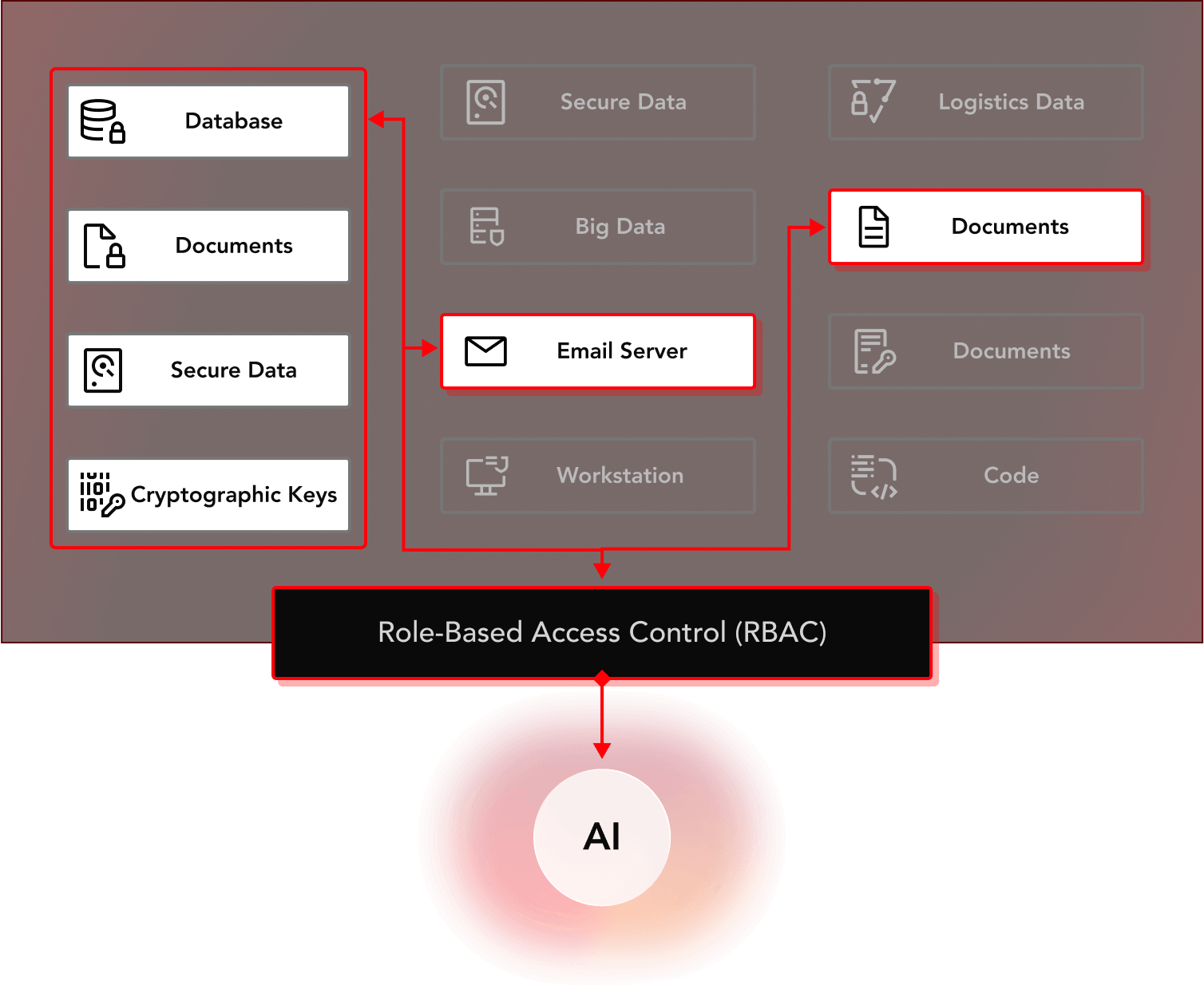
Role-Based Access Control (RBAC) and Attribute-Based Access Control (ABAC) work when users access known applications through stable roles or attribute-based rules. They are less effective in AI environments, where workflows are dynamic and spread across multiple domains.

Access Should Consider Relationships

In agentic AI, the issue is not whether an identity matches a role or attribute. The real question is whether the current relationship between the actor, task, data, and organization supports access in that moment. 

Roles and Attributes Can Change

An agent may be acting on behalf of a user for a specific project, under a limited scope, and against sensitive data that should not be exposed beyond that context. Static roles and attributes alone do not capture that level of complexity.
ReBAC-red
ReBAC

Intentionally Designed with Platform Auditability

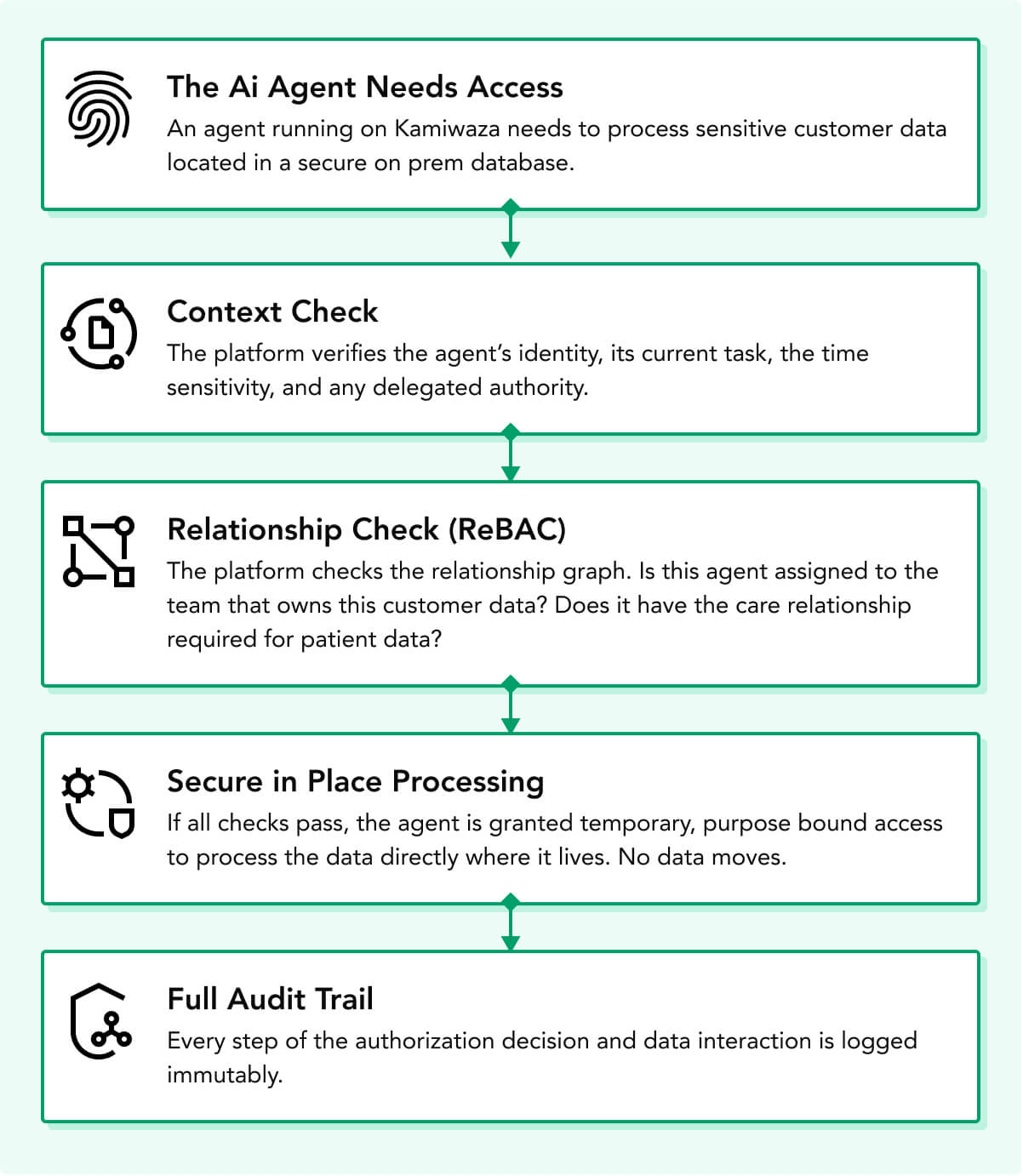
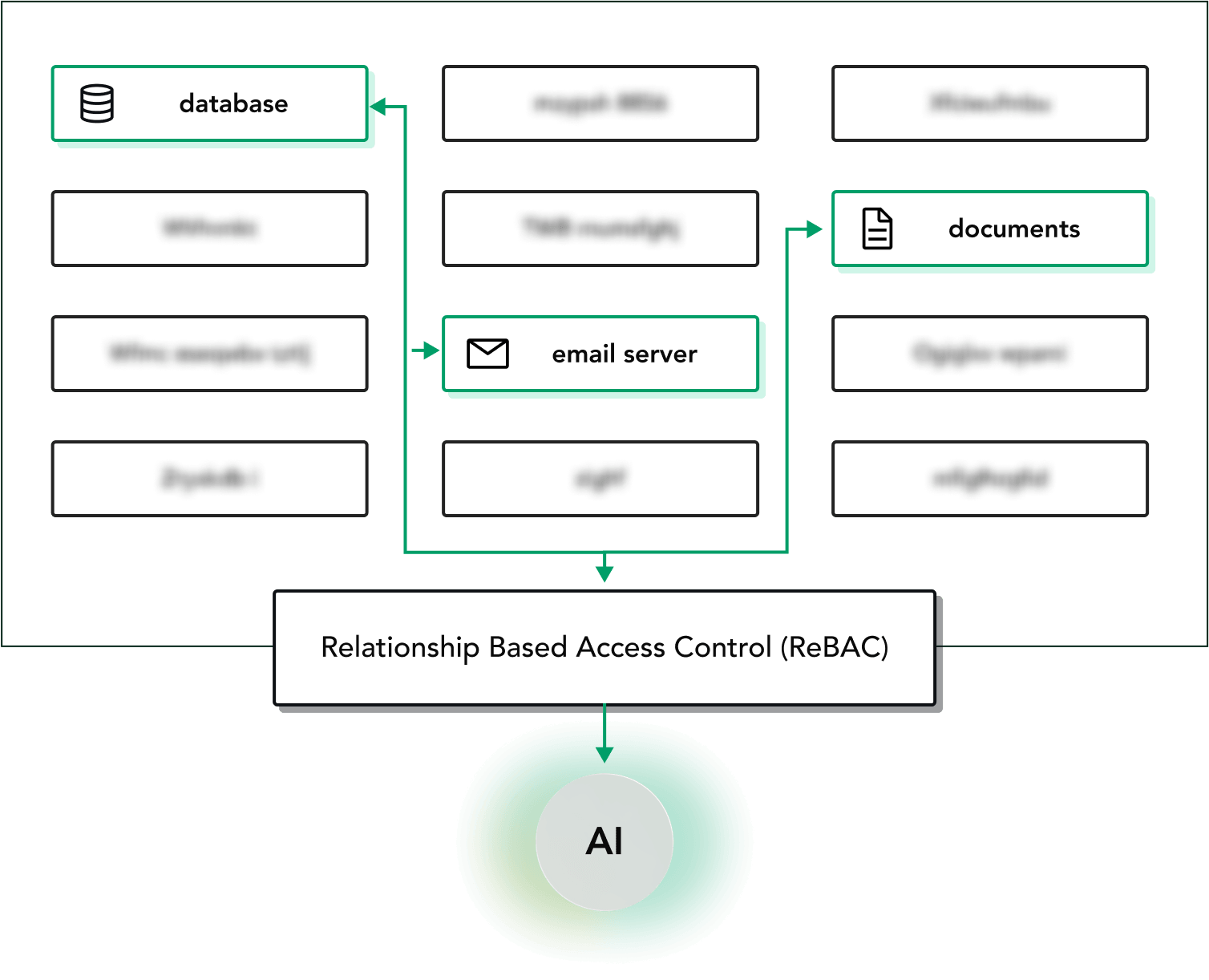
Kamiwaza enforces governed boundaries through contextual and relationship-based authorization. This is especially important for AI agent security, where access decisions must reflect user intent, delegated authority, project or department context, and the operating conditions of the workflow.

Relationship-Based Access Control (ReBAC)

ReBAC allows Kamiwaza to enforce access scope with greater precision than RBAC or ABAC were designed to provide. Rather than relying on static entitlements, it evaluates the relationships that matter at the time of execution, including department, project, team, delegated authority, data domain, and operating context.

ReBAC in Workrooms

Relationships are not limited to users and tools. They can also reflect departments, business units, projects, missions, and governed data domains. Kamiwaza Workrooms uses the same ReBAC model to maintain governed collaboration boundaries for work teams, helping ensure that access to tools and data aligns with the right working context.

Auditability through the AI action chain

Kamiwaza supports AI governance by tracing user activity, agent activity, authorization decisions, governed execution events, and released outputs as part of one continuous record. That supports compliance reporting, incident investigation, internal oversight, and authorization-oriented review processes in regulated and public sector environments.

Kamiwaza Governs the 
Full AI Chain

Many AI security approaches address one control layer well, but only one. Some are strongest at identity and access enforcement. Others emphasize model gateways, runtime controls, data controls, or observability. Those capabilities matter, but they do not govern AI across the full request-to-result path.

The gaps emerge at the transitions:

  • Control over the user does not automatically extend to the agent acting on that user’s behalf.

  • Protection of source data does not automatically cover metadata, embeddings, or other derived knowledge assets.

  • Approval of a model does not guarantee that the execution environment, node, or location meets policy. 

  • Logging after the fact does not prevent overexposure at the point of answer generation.

When these layers are handled separately, security fragments precisely where AI systems are most dynamic. Kamiwaza is designed to govern that full chain as one system. The advantage is not simply broader feature coverage. It is the ability to preserve context, policy, and traceability across the points where other approaches often introduce gaps.

infographic-how-it-works
resource-why-does-ai-need-rebac

Why Does AI Need ReBAC?

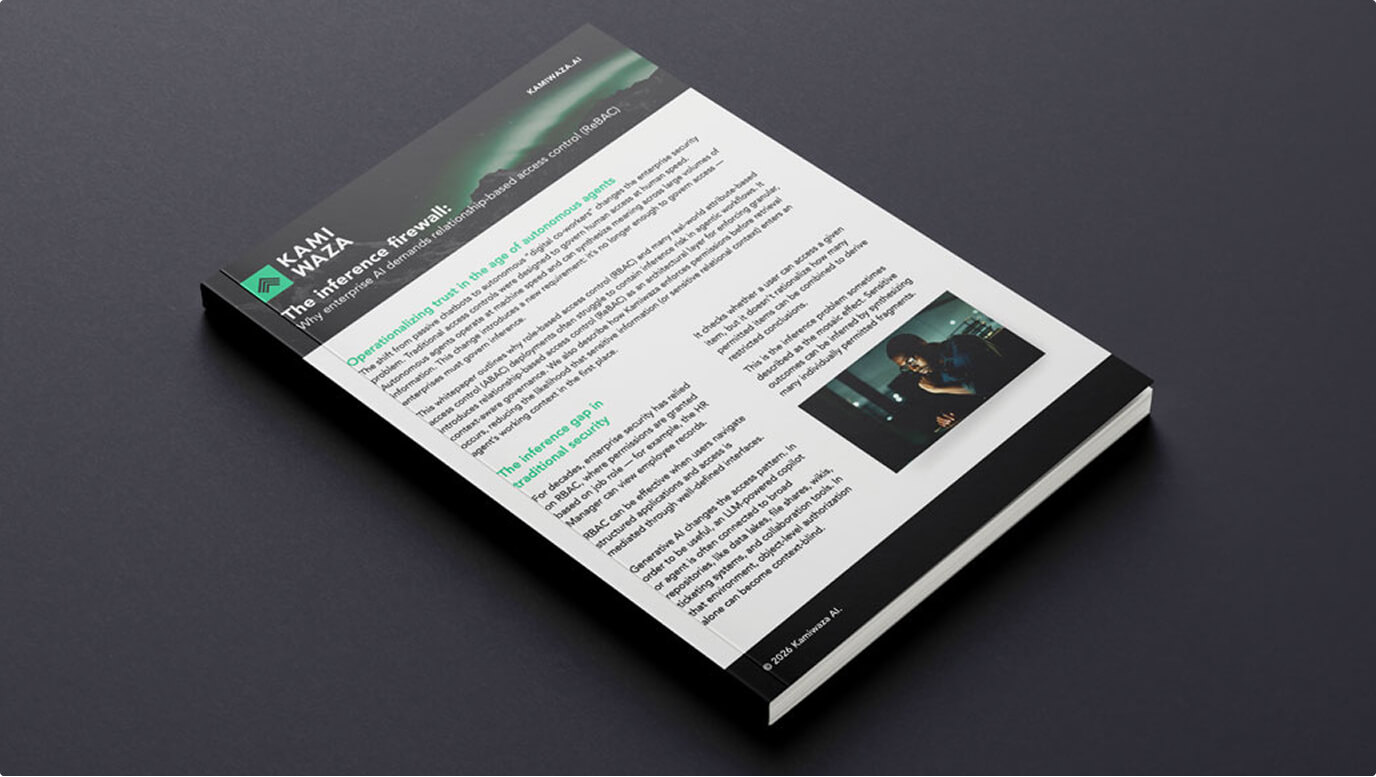
The shift from chatbots to autonomous agents has changed enterprise security architecture. Learn why ReBAC is critical to building an inference firewall that helps protect your data and organization.

FAQs About AI Security And Compliance

Why Does AI Present Unique Security Challenges?

AI systems need broad data access to deliver value, yet every access point creates vulnerability. Traditional security models are built for human users accessing specific applications. They break down when AI agents need to traverse multiple systems, correlate diverse data sources, and take autonomous actions. The more capable the AI, the greater the security challenge.

Many enterprises can’t reconcile AI’s potential with security requirements. Some attempt to isolate AI in sandboxed environments, minimizing its effectiveness. Others grant excessive permissions, creating unacceptable risks. Most simply delay adoption, waiting for someone else to solve the problem.

What Are the Differences Between RBAC and ReBAC?

Designed for human organizations, role-based access control (RBAC) revolutionized security by mapping permissions to roles rather than individuals. Enterprise security for AI extends this concept to relationship-based access control (ReBAC), recognizing that agent permissions depend not just on their role but on their relationships with data, systems, and other agents.

Consider a supply chain optimization agent. Its role might be “supply chain analyst,” but its actual permissions depend on relationships:

  • It relates to inventory data as a reader but to forecast models as an executor.
  • It maintains peer relationships with logistics agents, but subordinate relationships with procurement agents.
  • It accesses real-time data during operational hours, but only historical data during planning cycles.

These relationships create a dynamic security context that adapts to operational reality while maintaining strict controls. Permissions become contextual, temporal, and relationship-aware.

How Is Security Different for AI Agents Than for Human Users?

Traditional security thinks in terms of users: humans who log in, access resources, and log out. AI agents shatter this model. An AI agent might operate continuously, access dozens of systems, spawn sub-agents, and take autonomous actions. Because they work so differently from humans, AI agents require their own type of identity management.

How Can Enterprises Enforce Secure Boundaries 
for AI?

Security boundaries in traditional systems rely on network segmentation, firewalls, and access control lists. These mechanisms, designed for static infrastructure and human-speed interactions, can’t handle dynamic AI workloads that span organizational boundaries at machine speed.

Enterprise security for AI enforces boundaries architecturally:

  • Data locality enforcement ensures data never moves beyond authorized boundaries. When an AI agent needs to analyze data across regions, the analysis happens locally at each region, with only results crossing boundaries. Architecture makes unauthorized data movement impossible, not just prohibited.

  • Computational isolation runs AI workloads in isolated environments. Each agent operates in its own secure context, unable to access resources or memory belonging to other agents. Even on shared infrastructure, agents remain completely isolated.
  • Network microsegmentation creates granular network boundaries around each agent interaction. Instead of broad network zones, each agent operates within dynamically created micro-segments. Network access follows the principle of least privilege at the most granular level.
  • Temporal boundaries enforce time-based constraints architecturally. An agent authorized for real-time trading during market hours can’t access trading systems after hours, even if credentials remain valid. Time is an architectural boundary, not just a policy.
What Is AI Agent Identity Management and Contextual Authorization?

AI agents may run briefly for a single task or persist across extended workflows, but in both cases every request and action must be bound to the right requester context, delegated authority, operating scope, and a traceable path from requester to result. Static roles aren’t enough; the system needs to understand the current relationship between the actor, the task, the data domain and the organizational context so it can apply the correct permissions at that moment. This is how Kamiwaza enforces governed identity management for autonomous agents.

Contextual authorization extends that by asking not only “who” is making the request but also “why,” “when” and “how.” AI agents often need access to sensitive data across your enterprise, and traditional access tools that only check identity create massive security gaps. Contextual authorization evaluates the task being performed, the time limit and the chain of delegated authority before granting access. This ensures that agents act within precisely defined boundaries, preserving trust, auditability and compliance across the entire action chain.

How Can Enterprises Secure the Intelligence Supply Chain for AI?

Security boundaries in traditional systems rely on network segmentation, firewalls, and access control lists. These mechanisms, designed for static infrastructure and human-speed interactions, can’t handle dynamic AI workloads that span organizational boundaries at machine speed.

Enterprise security for AI enforces boundaries architecturally:

  • Data locality enforcement ensures data never moves beyond authorized boundaries. When an AI agent needs to analyze data across regions, the analysis happens locally at each region, with only results crossing boundaries. Architecture makes unauthorized data movement impossible, not just prohibited.

  • Computational isolation runs AI workloads in isolated environments. Each agent operates in its own secure context, unable to access resources or memory belonging to other agents. Even on shared infrastructure, agents remain completely isolated.
  • Network microsegmentation creates granular network boundaries around each agent interaction. Instead of broad network zones, each agent operates within dynamically created micro-segments. Network access follows the principle of least privilege at the most granular level.
  • Temporal boundaries enforce time-based constraints architecturally. An agent authorized for real-time trading during market hours can’t access trading systems after hours, even if credentials remain valid. Time is an architectural boundary, not just a policy.
How Does Zero Trust Security Apply to AI and AI Agents?

Zero trust security assumes no implicit trust, verifying every interaction regardless of source. When applied to AI systems, zero trust becomes even more critical. AI agents operate at machine speed, potentially accessing thousands of resources per second. A compromised agent could cause damage faster than any human attacker.

Zero-trust architectures require continuous verification. In an enterprise setting, this has several characteristics:

  • Request-level authentication validates every agent request, not just initial connections. Each API call, database query, or service invocation requires fresh authentication. Agents can’t ride on established sessions. Every action demands proof of identity and authorization.
  • Contextual authorization evaluates not just who’s asking, but why. An agent authorized to analyze customer data for service improvement can’t use that same access for marketing analysis. Context shapes permissions.
  • Behavioral attestation monitors agent behavior for anomalies. If a customer service agent suddenly starts accessing manufacturing data, security systems intervene immediately. Normal behavior patterns establish baselines, and deviations trigger alerts or automatic containment.
  • Cryptographic verification ensures agent integrity. Each agent’s code and configuration are cryptographically signed. Any modification, whether malicious or accidental, invalidates the agent’s identity.
How Can Enterprises Stay in Compliance with Data Privacy Regulations When Using AI?

Regulatory compliance typically constrains AI adoption. The General Data Protection Regulation (GDPR), Health Insurance Portability and Accountability Act (HIPAA), Sarbanes-Oxley Act (SOX), and countless other regulations seem to prohibit the data access AI requires. Enterprise security for AI transforms compliance from inhibitor to enabler.

By architecting security into every layer, compliance becomes automatic:

  • Data never moves beyond regulatory boundaries because architectural controls prevent it.
  • Access logs capture every interaction automatically, creating audit trails that exceed regulatory requirements.
  • Privacy preservation happens by design, not policy.
  • Security controls are cryptographically provable, not just documented.

Organizations implementing enterprise security for AI can deploy AI capabilities that competitors can’t, simply because their architecture makes compliance automatic.

planet

Deploy AI You Can Actually Trust

Stop trying to force outdated security onto modern AI. Choose a platform with intelligent, context-aware authorization built into its core. Make your distributed AI safe and governable from day one.